程序组合与高级运行时示例
普通 MessagePassing 直接使用 Torch,见入门。
本页的 matmul、complex VJP、recurrence 和 joint plan 用于检查原生 Tensor IR
或执行计划,因此暂时使用 tg.Tensor;它们不是 Torch 数学运算的替代教程。
核心片段省略的 imports 和输入可在每节折叠的完整源码中找到。
运行源码:
python examples/tensor_matmul.pypython examples/complex_autograd.pypython examples/linear_recurrence.pypython examples/graph_program.pypython examples/joint_autograd.pypython examples/torch_interop.pypython examples/torch_library.pypython examples/edge_nn_message_passing.py
linear_recurrence.py 需要 CUDA;其余脚本的设备选择见完整源码。
矩阵乘法与自动推导的梯度
矩阵乘法把 (M, K) 矩阵 lhs 与 (K, N) 矩阵 rhs 组合成
(M, N) 矩阵:元素 (i, j) 是 lhs 第 i 行与 rhs 第 j 列的
点积。当标量损失依赖于输出时,由链式法则,两个操作数的梯度
都可以写成与 G 的矩阵乘积——G 是损失对输出的上游导数
(即 cotangent,余切)。
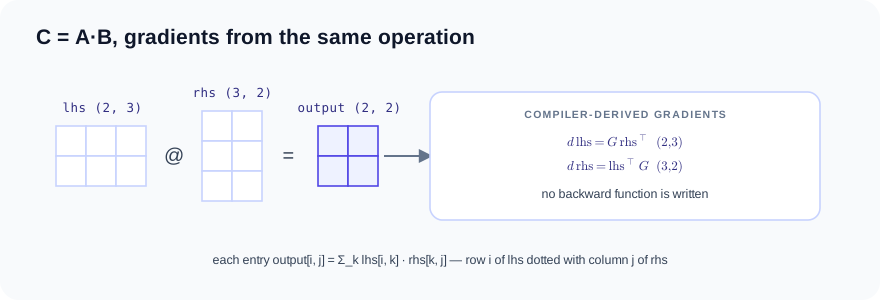
gf_tensor.matmul 是一等的 rank-2 收缩运算。示例把它 lowering 到
CPU LLVM 和 FP16 GPU tt.dot,两个矩阵操作数的梯度都由编译器
自动推导——无需手写 backward 函数。
lhs = tg.tensor(
    [[1.0, 2.0, 3.0], [4.0, 5.0, 6.0]], requires_grad=True)  # (M, K)
rhs = tg.tensor(
    [[2.0, 1.0], [0.0, 3.0], [4.0, -1.0]], requires_grad=True)  # (K, N)
cotangent = tg.tensor([[1.0, 2.0], [-1.0, 0.5]])  # (M, N)

output = lhs @ rhs  # (M, N)

dlhs, drhs = tg.autograd.grad(
    output, (lhs, rhs), grad_output=cotangent)
# d loss / d lhs = cotangent @ rhsᵀ
# d loss / d rhs = lhsᵀ @ cotangent
完整源码:examples/tensor_matmul.py(可直接运行)
"""Native Tiga Tensor matmul and compiler-derived reverse mode."""

import tiga as tg


lhs = tg.tensor(
    [[1.0, 2.0, 3.0], [4.0, 5.0, 6.0]], requires_grad=True)  # (M, K)
rhs = tg.tensor(
    [[2.0, 1.0], [0.0, 3.0], [4.0, -1.0]], requires_grad=True)  # (K, N)
cotangent = tg.tensor([[1.0, 2.0], [-1.0, 0.5]])  # (M, N)

output = lhs @ rhs  # (M, N)

dlhs, drhs = tg.autograd.grad(
    output, (lhs, rhs), grad_output=cotangent)
# d loss / d lhs = cotangent @ rhsᵀ
# d loss / d rhs = lhsᵀ @ cotangent

# Inspect the semantic Tensor IR: output.mlir()
本机编译产物(Ryzen 7 255 · RTX 5070 Ti 实测)
### output: Tensor IR (first lines)
module {
  func.func @tensor_main(%arg0: tensor<2x3xf32>, %arg1: tensor<3x2xf32>) -> tensor<2x2xf32> {
    %0 = "gf_tensor.input"(%arg0) <{offset = 0 : i64, strides = array<i64: 3, 1>}> : (tensor<2x3xf32>) -> tensor<2x3xf32>
    %1 = "gf_tensor.input"(%arg1) <{offset = 0 : i64, strides = array<i64: 2, 1>}> : (tensor<3x2xf32>) -> tensor<3x2xf32>
    %2 = "gf_tensor.matmul"(%0, %1) : (tensor<2x3xf32>, tensor<3x2xf32>) -> tensor<2x2xf32>
    return %2 : tensor<2x2xf32>
  }
}
### output: Tensor IR (first lines)
module {
  func.func @tensor_main(%arg0: tensor<2x3xf32>, %arg1: tensor<3x2xf32>) -> tensor<2x2xf32> {
    %0 = "gf_tensor.input"(%arg0) <{offset = 0 : i64, strides = array<i64: 3, 1>}> : (tensor<2x3xf32>) -> tensor<2x3xf32>
    %1 = "gf_tensor.input"(%arg1) <{offset = 0 : i64, strides = array<i64: 2, 1>}> : (tensor<3x2xf32>) -> tensor<3x2xf32>
    %2 = "gf_tensor.matmul"(%0, %1) : (tensor<2x3xf32>, tensor<3x2xf32>) -> tensor<2x2xf32>
    return %2 : tensor<2x2xf32>
  }
}
复数 VJP
信号处理和物理计算常把数据存储为复数 a + bi,其中 i 为虚数 单位。转置这样的张量应该只改变索引方式——一个零拷贝视图—— 而不是复制内存;对这个非连续视图做 reshape 时,才会按视图 顺序真正物化元素。复数输出还需要一套微分约定,因为普通的 实数导数不能直接套用:Tiga 采用共轭 Wirtinger 约定, 把 x 与其复共轭视为独立变量,并要求为复数输出显式提供 cotangent。在该约定下,模平方 |y|² 的梯度为 2·x。
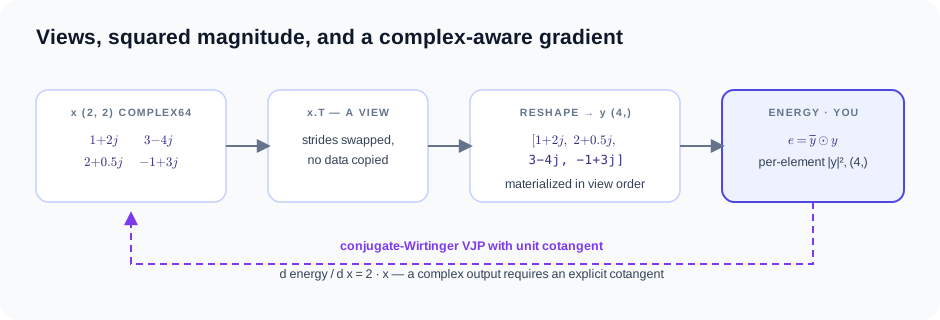
该示例在原生 CPU 运行时上演示了 complex64 存储、带步长的 零拷贝视图,以及显式的共轭 Wirtinger cotangent。
x = tg.tensor(
    [[1.0 + 2.0j, 3.0 - 4.0j], [2.0 + 0.5j, -1.0 + 3.0j]],
    requires_grad=True,
)  # (2, 2)

# Transpose is a zero-copy strided view. The following reshape materializes
# logical transpose order because that view is not contiguous.
y = x.T.reshape(-1)  # (4,)

energy_terms = y.conj() * y  # (4,)

# Complex outputs require an explicit cotangent. Tiga uses the
# conjugate-Wirtinger VJP convention.
dx = tg.autograd.grad(
    energy_terms,
    x,
    grad_output=tg.tensor([1.0 + 0.0j] * 4),
)
# d energy_terms / d x = 2x (conjugate-Wirtinger, unit cotangent)
完整源码:examples/complex_autograd.py(可直接运行)
"""Complex storage, views and conjugate-Wirtinger VJP."""

import tiga as tg


x = tg.tensor(
    [[1.0 + 2.0j, 3.0 - 4.0j], [2.0 + 0.5j, -1.0 + 3.0j]],
    requires_grad=True,
)  # (2, 2)

# Transpose is a zero-copy strided view. The following reshape materializes
# logical transpose order because that view is not contiguous.
y = x.T.reshape(-1)  # (4,)

energy_terms = y.conj() * y  # (4,)

# Complex outputs require an explicit cotangent. Tiga uses the
# conjugate-Wirtinger VJP convention.
dx = tg.autograd.grad(
    energy_terms,
    x,
    grad_output=tg.tensor([1.0 + 0.0j] * 4),
)
# d energy_terms / d x = 2x (conjugate-Wirtinger, unit cotangent)
本机编译产物(Ryzen 7 255 · RTX 5070 Ti 实测)
### y: Tensor IR (first lines)
module {
  func.func @tensor_main(%arg0: tensor<2x2xcomplex<f32>>) -> tensor<4xcomplex<f32>> {
    %0 = "gf_tensor.input"(%arg0) <{offset = 0 : i64, strides = array<i64: 2, 1>}> : (tensor<2x2xcomplex<f32>>) -> tensor<2x2xcomplex<f32>>
    %1 = "gf_tensor.permute"(%0) <{axes = array<i64: 1, 0>}> : (tensor<2x2xcomplex<f32>>) -> tensor<2x2xcomplex<f32>>
    %2 = "gf_tensor.reshape"(%1) <{shape = array<i64: 4>}> : (tensor<2x2xcomplex<f32>>) -> tensor<4xcomplex<f32>>
    return %2 : tensor<4xcomplex<f32>>
  }
}
### y: Tensor IR (first lines)
module {
  func.func @tensor_main(%arg0: tensor<2x2xcomplex<f32>>) -> tensor<4xcomplex<f32>> {
    %0 = "gf_tensor.input"(%arg0) <{offset = 0 : i64, strides = array<i64: 2, 1>}> : (tensor<2x2xcomplex<f32>>) -> tensor<2x2xcomplex<f32>>
    %1 = "gf_tensor.permute"(%0) <{axes = array<i64: 1, 0>}> : (tensor<2x2xcomplex<f32>>) -> tensor<2x2xcomplex<f32>>
    %2 = "gf_tensor.reshape"(%1) <{shape = array<i64: 4>}> : (tensor<2x2xcomplex<f32>>) -> tensor<4xcomplex<f32>>
    return %2 : tensor<4xcomplex<f32>>
  }
}
用 map/cumsum/contract 拼出线性递推
递推的每一步输出都由之前的步骤算出,而不是一次性算出所有 结果。本示例是因果线性注意力——若干高效序列模型的核心: 序列共 S 步,第 s 步贡献键向量 k_s 和值向量 v_s;第 t 步 输出历史值的加权和,权重是每个历史键与当前查询 q_t 的 相似度。“因果”指第 t 步只能读取 s ≤ t 的步骤。折叠成 递推形式后,递推状态不断累积外积 k_s ⊗ v_s,每个输出就是 查询对该状态的一次读出。
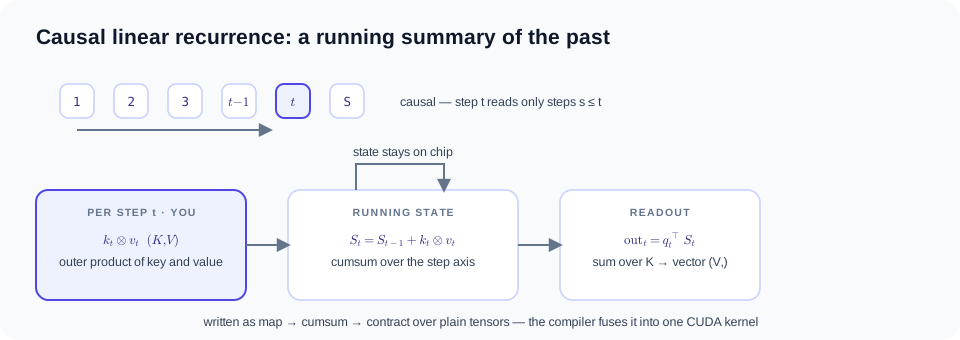
这个表达式就是一个普通的 Tensor map/cumsum/contract 程序—— 并没有内置的线性注意力算子。在已注册的 CUDA 形状族上, 编译器会识别出 map → scan → contract 结构,生成一个递推 kernel,其状态始终留在片上。
state_shape = (lanes, steps, key_width, value_width)  # (L, S, K, V)
updates = (  # (L, S, K, V)
    k.unsqueeze(-1).broadcast_to(state_shape)
    * v.unsqueeze(-2).broadcast_to(state_shape)
)
output = (  # (L, S, V)
    q.unsqueeze(-1).broadcast_to(state_shape) * updates.cumsum(1)
).sum(axis=2)
完整源码:examples/linear_recurrence.py(可直接运行)
"""A causal linear recurrence expressed with ordinary Tiga tensors."""

import torch

import tiga as tg


lanes, steps, key_width, value_width = 4, 128, 16, 16
q_torch = torch.randn(lanes, steps, key_width, device="cuda")      # (L, S, K)
k_torch = torch.randn_like(q_torch)                                # (L, S, K)
v_torch = torch.randn(lanes, steps, value_width, device="cuda")    # (L, S, V)
q, k, v = map(tg.from_torch, (q_torch, k_torch, v_torch))

state_shape = (lanes, steps, key_width, value_width)  # (L, S, K, V)
updates = (  # (L, S, K, V)
    k.unsqueeze(-1).broadcast_to(state_shape)
    * v.unsqueeze(-2).broadcast_to(state_shape)
)
output = (  # (L, S, V)
    q.unsqueeze(-1).broadcast_to(state_shape) * updates.cumsum(1)
).sum(axis=2)

actual = output.to_torch()

# Inspect: output.execution, output.generated_code("ttir"), output.expression()
本机编译产物(Ryzen 7 255 · RTX 5070 Ti 实测)
### output: execution record
backend: cuda-ttir-triton
compile_ms: 553.722441
materialize_ms: 0.0
saved_bytes: 0
saved_compile_ms: 0.0
checkpoint_plan: {'candidate_count': 0, 'delegated_candidate_count': 0, 'decisions': (), 'memory_budget_bytes': -1, 'spill_budget_bytes': 0, 'planned_saved_bytes': 0, 'planned_spilled_bytes': 0, 'actual_spilled_bytes': 0, 'spill_transfer_ms': 0.0, 'tiers': (), 'recompute_costs': (), 'live_intervals': (), 'peak_live_bytes': 0, 'peak_spill_bytes': 0, 'planning_ms': 0.0, 'native_load_ms': 0.0, 'ir': ''}
cache_hit: False
fast_math: False
launch_ms: 0.154881
artifact: triton-cache/034bf974a1da5e8f3e4103ba
source: // tiga.tensor entry=gf_tensor_scan_contract block_rows=1 block_elements=16 num_warps=1 abi=arg0,arg1,arg2,out
module {
  tt.func public @gf_tensor_scan_contract(%arg0: !tt.ptr<f32>, %arg1: !tt.ptr<f32>, %arg2: !tt.ptr<f32>, %out: !tt.ptr<f32>) attributes {noinline = false} {
    %pid_i32 = tt.get_program_id x : i32
    %pid = arith.extui %pid_i32 : i32 to i64
    %value_tiles = arith.constant 1 : i64
    %lane = arith.divui %pid, %value_tiles : i64
    %value_tile = arith.remui %pid, %value_tiles : i64
    %k_i32 = tt.make_range {end = 16 : i32, start = 0 : i32} : tensor<16xi32>
    %v_i32 = tt.make_range {end = 16 : i32, start = 0 : i32} : tensor<16xi32>
    %k_lane = arith.extsi %k_i32 : tensor<16xi32> to tensor<16xi64>
    %v_lane = arith.extsi %v_i32 : tensor<16xi32> to tensor<16xi64>
    %k_bound = arith.constant dense<16> : tensor<16xi64>
    %k_mask = arith.cmpi slt, %k_lane, %k_bound : tensor<16xi64>
    %sixteen = arith.constant 16 : i64
    %v_base = arith.muli %value_tile, %sixteen : i64
    %v_base_vec = tt.splat %v_base : i64 -> tensor<16xi64>
    %v_column = arith.addi %v_base_vec, %v_lane : tensor<16xi64>
    %v_bound = arith.constant dense<16> : tensor<16xi64>
    %v_mask = arith.cmpi slt, %v_column, %v_bound : tensor<16xi64>
    %zero_k = arith.constant dense<0.000000e+00> : tensor<16xf32>
    %zero_v = arith.constant dense<0.000000e+00> : tensor<16xf32>
    %zero_state = arith.constant dense<0.000000e+00> : tensor<16x16xf32>
    %steps_i64 = arith.constant 128 : i64
    %key_width = arith.constant 16 : i64
    %value_width = arith.constant 16 : i64
    %begin = arith.constant 0 : index
    %end = arith.constant 128 : index
    %one = arith.constant 1 : index
    %scan = scf.for %time = %begin to %end step %one iter_args(%state = %zero_state) -> (tensor<16x16xf32>) {
      %time_i64 = arith.index_cast %time : index to i64
      %lane_time_base = arith.muli %lane, %steps_i64 : i64
      %lane_time = arith.addi %lane_time_base, %time_i64 : i64
      %qk_base = arith.muli %lane_time, %key_width : i64
      %qk_base_v = tt.splat %qk_base : i64 -> tensor<16xi64>
      %qk_index = arith.addi %qk_base_v, %k_lane : tensor<16xi64>
      %q_base = tt.splat %arg0 : !tt.ptr<f32> -> tensor<16x!tt.ptr<f32>>
      %k_base = tt.splat %arg1 : !tt.ptr<f32> -> tensor<16x!tt.ptr<f32>>
      %q_ptr = tt.addptr %q_base, %qk_index : tensor<16x!tt.ptr<f32>>, tensor<16xi64>
      %k_ptr = tt.addptr %k_base, %qk_index : tensor<16x!tt.ptr<f32>>, tensor<16xi64>
      %q = tt.load %q_ptr, %k_mask, %zero_k : tensor<16x!tt.ptr<f32>>
      %k = tt.load %k_ptr, %k_mask, %zero_k : tensor<16x!tt.ptr<f32>>
      %value_time_base = arith.muli %lane_time, %value_width : i64
      %value_time_base_v = tt.splat %value_time_base : i64 -> tensor<16xi64>
      %v_index = arith.addi %value_time_base_v, %v_column : tensor<16xi64>
      %v_input_base = tt.splat %arg2 : !tt.ptr<f32> -> tensor<16x!tt.ptr<f32>>
      %v_ptr = tt.addptr %v_input_base, %v_index : tensor<16x!tt.ptr<f32>>, tensor<16xi64>
      %v = tt.load %v_ptr, %v_mask, %zero_v : tensor<16x!tt.ptr<f32>>
      %k2 = tt.expand_dims %k {axis = 1 : i32} : tensor<16xf32> -> tensor<16x1xf32>
      %v2 = tt.expand_dims %v {axis = 0 : i32} : tensor<16xf32> -> tensor<1x16xf32>
      %kb = tt.broadcast %k2 : tensor<16x1xf32> -> tensor<16x16xf32>
      %vb = tt.broadcast %v2 : tensor<1x16xf32> -> tensor<16x16xf32>
      %outer = arith.mulf %kb, %vb : tensor<16x16xf32>
      %next_state = arith.addf %state, %outer : tensor<16x16xf32>
      %q2 = tt.expand_dims %q {axis = 1 : i32} : tensor<16xf32> -> tensor<16x1xf32>
      %qb = tt.broadcast %q2 : tensor<16x1xf32> -> tensor<16x16xf32>
      %weighted = arith.mulf %next_state, %qb : tensor<16x16xf32>
      %partial = "tt.reduce"(%weighted) <{axis = 0 : i32}> ({
      ^bb0(%a: f32, %b: f32):
        %combined = arith.addf %a, %b : f32
        tt.reduce.return %combined : f32
      }) : (tensor<16x16xf32>) -> tensor<16xf32>
      %out_base_scalar = arith.muli %lane_time, %value_width : i64
      %out_base_v = tt.splat %out_base_scalar : i64 -> tensor<16xi64>
      %out_index = arith.addi %out_base_v, %v_column : tensor<16xi64>
      %out_base = tt.splat %out : !tt.ptr<f32> -> tensor<16x!tt.ptr<f32>>
      %out_ptr = tt.addptr %out_base, %out_index : tensor<16x!tt.ptr<f32>>, tensor<16xi64>
      tt.store %out_ptr, %partial, %v_mask : tensor<16x!tt.ptr<f32>>
      scf.yield %next_state : tensor<16x16xf32>
    }
    tt.return
  }
}

ir: module {
  func.func @tensor_main(%arg0: tensor<4x128x16xf32>, %arg1: tensor<4x128x16xf32>, %arg2: tensor<4x128x16xf32>) -> tensor<4x128x16xf32> {
    %0 = "gf_tensor.input"(%arg0) <{offset = 0 : i64, strides = array<i64: 2048, 16, 1>}> : (tensor<4x128x16xf32>) -> tensor<4x128x16xf32>
    %1 = "gf_tensor.reshape"(%0) <{shape = array<i64: 4, 128, 16, 1>}> : (tensor<4x128x16xf32>) -> tensor<4x128x16x1xf32>
    %2 = "gf_tensor.broadcast"(%1) <{shape = array<i64: 4, 128, 16, 16>}> : (tensor<4x128x16x1xf32>) -> tensor<4x128x16x16xf32>
    %3 = "gf_tensor.input"(%arg1) <{offset = 0 : i64, strides = array<i64: 2048, 16, 1>}> : (tensor<4x128x16xf32>) -> tensor<4x128x16xf32>
    %4 = "gf_tensor.reshape"(%3) <{shape = array<i64: 4, 128, 16, 1>}> : (tensor<4x128x16xf32>) -> tensor<4x128x16x1xf32>
    %5 = "gf_tensor.broadcast"(%4) <{shape = array<i64: 4, 128, 16, 16>}> : (tensor<4x128x16x1xf32>) -> tensor<4x128x16x16xf32>
    %6 = "gf_tensor.input"(%arg2) <{offset = 0 : i64, strides = array<i64: 2048, 16, 1>}> : (tensor<4x128x16xf32>) -> tensor<4x128x16xf32>
    %7 = "gf_tensor.reshape"(%6) <{shape = array<i64: 4, 128, 1, 16>}> : (tensor<4x128x16xf32>) -> tensor<4x128x1x16xf32>
    %8 = "gf_tensor.broadcast"(%7) <{shape = array<i64: 4, 128, 16, 16>}> : (tensor<4x128x1x16xf32>) -> tensor<4x128x16x16xf32>
    %9 = "gf_tensor.mul"(%5, %8) : (tensor<4x128x16x16xf32>, tensor<4x128x16x16xf32>) -> tensor<4x128x16x16xf32>
    %10 = "gf_tensor.cumsum"(%9) <{axis = 1 : i64, reverse = false}> : (tensor<4x128x16x16xf32>) -> tensor<4x128x16x16xf32>
    %11 = "gf_tensor.mul"(%2, %10) : (tensor<4x128x16x16xf32>, tensor<4x128x16x16xf32>) -> tensor<4x128x16x16xf32>
    %12 = "gf_tensor.reduce_sum"(%11) <{axes = array<i64: 2>, keep_dims = false}> : (tensor<4x128x16x16xf32>) -> tensor<4x128x16xf32>
    return %12 : tensor<4x128x16xf32>
  }
}

semantic_hash: 034bf974a1da5e8f3e4103baebe98bcd893cb3f4915b121fc16715c99030c4f3
artifacts: {'ttir', 'ttgir', 'llir', 'ptx', 'cubin'}  # ~80 KB of artifacts omitted; full text via kernel.code("ptx")
@tg.jit 跨 kernel SSA 捕获
它是什么。 一个加权图求和,计算两次。一张包含 N = 4096 个节点、
E = 16·N 条边的图,以压缩稀疏行(CSR)格式存储——一个行偏移数组加一个列索引数组。
每个节点 i 沿其入边 e = (j→i),把源值 x[j] 乘以边权后求和。程序分别用两个
不同的权重向量 w0 和 w1 各算一遍,每个权重向量各返回一个 (N,) 结果。
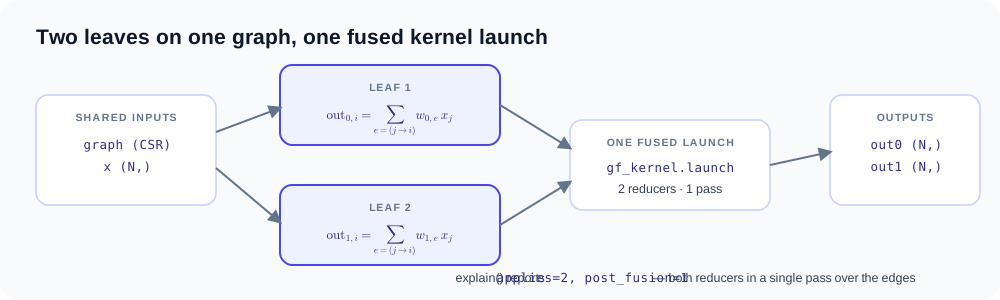
两个 WeightedSum 调用读取同一张图和同一份特征,因此 @tg.jit 的自动捕获将它们
登记为带类型的静态单赋值(SSA)叶子,再横向融合成单个 gf_kernel.launch,
由该 launch 携带两个 reducer——explain() 报告 applies=2, post_fusion=1。整个过程
没有显式的编译调用:首次观测即触发即时(JIT)编译,Kernel IR 与 PTX(NVIDIA
GPU 汇编)随时可查看。这是第一个可执行的 provider 示例,CUDA 存储由可选的
Torch 适配器提供。
只要 @tg.jit:循环捕获和跨 kernel 融合都是自动的。@tg.jit 把
for/while 循环改写成 gf_control.repeat / gf_control.while
区域,同时自动激活 program 上下文——直线部分里的每个 MessagePassing
调用仍然成为带类型的 SSA 叶子,跨 kernel 边界融合;两个
WeightedSum 调用共享一次 launch 靠的就是它。循环体保持逐迭代语义:
staged 区域内调用的 kernel 内联进循环体,而不会注册成顶层叶子;SSA
叶子可以直接参与张量算术,因此 Picard 风格的 state + apply(state)
循环在 @tg.jit 下照常工作(再叠一层 @tg.program 也合法)。
tg.program 保留为兼容入口:面向无法提供源码的直线代码场景,只激活
同一个上下文,不做 AST 改写。
自动微分同样穿过边界:任一捕获字段带 requires_grad 时叶子可微,
反向逐叶子把其 kernel 重新内联展开求 VJP——不融合,前向则保持融合
launch;共享同一输入的叶子会累加各自的梯度贡献。没有可微内联展开的
叶子形态(provider 持有的字段、原生支持集合之外的关系实现)直接报
NotImplementedError,绝不返回静默错误的梯度。
class WeightedSum(tg.MessagePassing):
    reducer = tg.sum()

    def edge(self, src, dst, edge):
        return src.x * edge.weight


# Regular degree-16 relation: dst i gathers from sources (i*degree + k) % N.
graph = tg.Graph.regular(nodes, degree, device=device)


@tg.jit
def two_observables():
    # @tg.jit captures the two sibling kernel calls automatically; there is
    # no explicit gf.compile() and no separate composition decorator.
    return (
        WeightedSum()(graph=graph, src={"x": x}, dst={},
                      edge={"weight": w0}),  # (N,)
        WeightedSum()(graph=graph, src={"x": x}, dst={},
                      edge={"weight": w1}),  # (N,)
    )


first, second = two_observables()
# The two leaves are planned as one fused kernel launch.
完整源码:examples/graph_program.py(可直接运行)
"""Automatic horizontal fusion across two MessagePassing leaf calls."""

import torch

import tiga as tg

device = "cuda" if torch.cuda.is_available() else "cpu"
nodes, degree = 4096, 16
x = torch.randn(nodes, device=device)                                        # (N,)
w0 = torch.randn(nodes * degree, device=device)                              # (E,)
w1 = torch.randn(nodes * degree, device=device)                              # (E,)


class WeightedSum(tg.MessagePassing):
    reducer = tg.sum()

    def edge(self, src, dst, edge):
        return src.x * edge.weight


# Regular degree-16 relation: dst i gathers from sources (i*degree + k) % N.
graph = tg.Graph.regular(nodes, degree, device=device)


@tg.jit
def two_observables():
    # @tg.jit captures the two sibling kernel calls automatically; there is
    # no explicit gf.compile() and no separate composition decorator.
    return (
        WeightedSum()(graph=graph, src={"x": x}, dst={},
                      edge={"weight": w0}),  # (N,)
        WeightedSum()(graph=graph, src={"x": x}, dst={},
                      edge={"weight": w1}),  # (N,)
    )


first, second = two_observables()
# The two leaves are planned as one fused kernel launch.

if device == "cuda":
    out0, out1 = first.program.run()  # observation triggers JIT

# Inspect: first.program.explain(), first.program.ir("kernel"),
#          first.program.code("ptx")
本机编译产物(Ryzen 7 255 · RTX 5070 Ti 实测)
### WeightedSumTorchExecutor  (leaf 0 of 2 — identical for leaf 1)
backend: cpu
provider: torch.sparse.mm
lowering: dispatch-native-sparse-mm
passes: gf-verify-domain, gf-lower-domain-to-iter, gf-lower-iter-to-kernel, capture-edge-expression, recognize-linear-weighted-sum, dispatch-native-sparse-mm
remark: [planning] no profitable generated specialization was proven; dispatched native sparse library
# no fused product kernel exists off CUDA: each apply runs as an
# ordinary kernel; the fusion stays an IR-level plan.
联合前向/反向 DAG
它是什么。 在一个微小函数上做反向模式自动微分。给定向量 x = [2, 3],
程序计算损失——各分量平方之和——以及损失对 x 的梯度。这里的梯度 pass 是一个
VJP(向量–雅可比积):把标量损失导数沿每个操作反向传播到所有输入,
本例中就归结为规则“x² 的导数是 2x”。
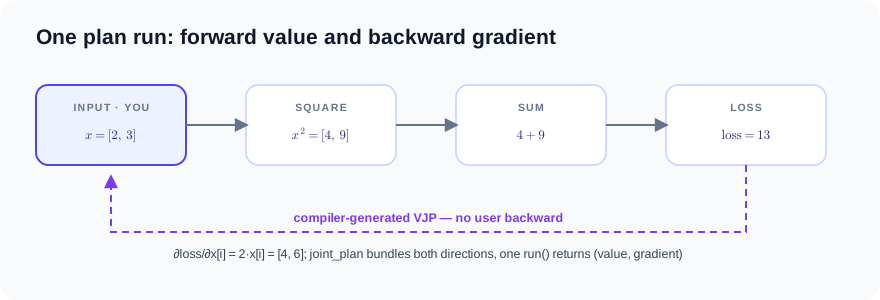
tg.autograd.joint_plan 把前向和编译器推导出的 VJP 打包成一个可查看的
依赖 DAG,并自动插入 checkpoint;一次 plan.run() 同时返回函数值和
梯度——无需用户手写反向。plan 不关心存储来自哪里:torch 存储经
tg.from_torch 零拷贝进入,结果用 .to_torch(copy=True) 读回——只有
出口这一次拷贝,因为结果是 Tiga 算出来的,不是从 torch 包装的。
xt = torch.tensor([2.0, 3.0], requires_grad=True)  # (2,) torch storage
x = tg.from_torch(xt, requires_grad=True)          # zero-copy into tg.Tensor
loss = (x * x).sum()                               # scalar deferred DAG
plan = tg.autograd.joint_plan(loss, x, checkpoint="auto")
value, dx = plan.run()
# loss = 2² + 3² = 13; dx = 2x = [4, 6]
dx.to_torch(copy=True)  # gf-computed results: one copy back out
完整源码:examples/joint_autograd.py(可直接运行)
"""One inspectable execution DAG for forward and compiler-generated VJP."""

import torch

import tiga as tg

xt = torch.tensor([2.0, 3.0], requires_grad=True)  # (2,) torch storage
x = tg.from_torch(xt, requires_grad=True)          # zero-copy into tg.Tensor
loss = (x * x).sum()                               # scalar deferred DAG
plan = tg.autograd.joint_plan(loss, x, checkpoint="auto")
value, dx = plan.run()
# loss = 2² + 3² = 13; dx = 2x = [4, 6]
dx.to_torch(copy=True)  # gf-computed results: one copy back out

# Inspect: plan.explain()  — forward/backward executable bundle summary
本机编译产物(Ryzen 7 255 · RTX 5070 Ti 实测)
### plan: JointAutogradPlan
executable bundle: invocations=2 snapshot=0
structure hash: 61e2b07488ff42fc
bindings: output, gradient:0
  forward (autograd-forward) <- ready; output:write
  backward:0 (autograd-backward) <- forward; output:read, gradient:0:write
checkpoint/spill decisions are consumed while each backward executable is physicalized

### dx: execution record
backend: python-oracle
native_error: None

### loss: execution record
backend: python-oracle
native_error: None

### value: execution record
backend: python-oracle
native_error: None
### plan: JointAutogradPlan
executable bundle: invocations=2 snapshot=0
structure hash: 61e2b07488ff42fc
bindings: output, gradient:0
  forward (autograd-forward) <- ready; output:write
  backward:0 (autograd-backward) <- forward; output:read, gradient:0:write
checkpoint/spill decisions are consumed while each backward executable is physicalized

### dx: execution record
backend: python-oracle
native_error: None

### loss: execution record
backend: python-oracle
native_error: None

### value: execution record
backend: python-oracle
native_error: None
默认 Torch 接口与可选原生存储桥
它是什么。 环上的邻居求和,外加存储共享。八个节点构成一个环:每个
节点恰好有两条入边,分别来自两个相邻节点,权重均为 1——因此每个节点的
输出是其两个邻居值之和。另外,原生 tg.Tensor 可以由 Torch 张量创建,
也能转换回去,两个方向共享同一份底层存储。
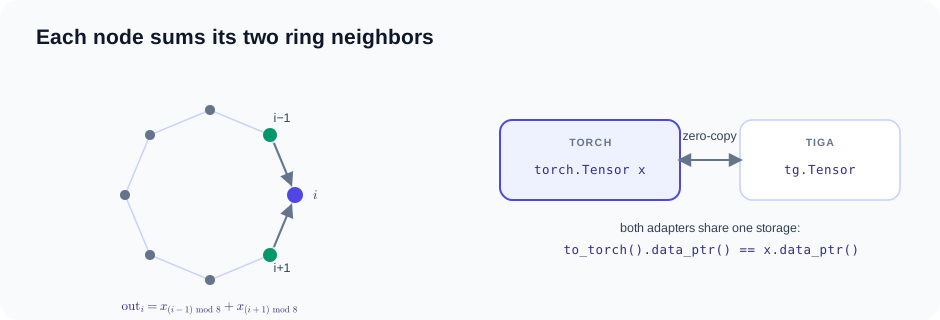
Torch 张量直接调用 MessagePassing UDF——无转换、无拷贝;Torch 由使用者单独安装,不是默认安装依赖。
原生编译器和底层运行时仍可独立工作。tg.from_torch/to_torch 这对 API 只用于另一个
方向:进入原生 tg.Tensor 体系(延迟捕获、编译器 VJP),同时仍共享
torch 存储——相同的数据指针证实了这一点。目前需要原生结构化控制流捕获的场景才要求此转换:@tg.jit 循环和 linear_solve / nonlinear_solve
驱动器会把迭代具象化为 gf_control.repeat / gf_control.while,因此
它们的向量必须是 tg.Tensor(在那里传 torch 张量会抛 TypeError)。
惰性 JIT 对象会暴露 gf.kernel
选定的机器调度,经过验证且与 provider 无关。
class WeightedAggregation(tg.MessagePassing):
    reducer = tg.sum()

    def edge(self, src, dst, edge):
        return edge.weight * src.x


# Ring adjacency with unit weights: out[i] = x[(i-1) mod N] + x[(i+1) mod N].
row_ptr = torch.arange(0, nodes * degree + 1, degree, dtype=torch.int64)  # (N+1,)
col_idx = (  # (E,)
    torch.arange(nodes)[:, None] + torch.tensor([-1, 1])
).remainder(nodes).flatten()

# Torch tensors call the UDF directly — no conversion, no copy.
graph = tg.Graph.from_csr(row_ptr, col_idx, num_src=nodes, validate="full")
kernel = WeightedAggregation()
output = kernel(  # (N,)
    graph=graph, src={"x": x}, dst={}, edge={"weight": weight})
完整源码:examples/torch_interop.py(可直接运行)
"""Default Torch interface, plus an optional native-storage round trip."""

import torch

import tiga as tg

nodes, degree = 8, 2
x = torch.linspace(0, 1, nodes)                                            # (N,)
weight = torch.ones(nodes * degree)                                        # (E,)


class WeightedAggregation(tg.MessagePassing):
    reducer = tg.sum()

    def edge(self, src, dst, edge):
        return edge.weight * src.x


# Ring adjacency with unit weights: out[i] = x[(i-1) mod N] + x[(i+1) mod N].
row_ptr = torch.arange(0, nodes * degree + 1, degree, dtype=torch.int64)  # (N+1,)
col_idx = (  # (E,)
    torch.arange(nodes)[:, None] + torch.tensor([-1, 1])
).remainder(nodes).flatten()

# Torch tensors call the UDF directly — no conversion, no copy.
graph = tg.Graph.from_csr(row_ptr, col_idx, num_src=nodes, validate="full")
kernel = WeightedAggregation()
output = kernel(  # (N,)
    graph=graph, src={"x": x}, dst={}, edge={"weight": weight})

# from_torch/to_torch are NOT required for the call above. They exist for the
# other direction: entering the native tg.Tensor system (deferred expression
# capture, compiler-generated VJP) while still sharing torch storage.
native = tg.from_torch(x)
round_trip = native.to_torch()  # same storage, zero copy

# Inspect: kernel.explain(), kernel.schedules
#          (schedule.resources, schedule.roles, schedule.instructions)
本机编译产物(Ryzen 7 255 · RTX 5070 Ti 实测)
### WeightedAggregationTorchExecutor
backend: cpu
provider: torch.sparse.mm
lowering: dispatch-native-sparse-mm
passes: gf-verify-domain, gf-lower-domain-to-iter, gf-lower-iter-to-kernel, capture-edge-expression, recognize-linear-weighted-sum, dispatch-native-sparse-mm
accepted: [machine-schedule] admitted fixed-row-neighbor
unknown: [pipeline] no compiler-controlled asynchronous pipeline admitted
remark: [planning] no profitable generated specialization was proven; dispatched native sparse library
variant cache: hits=0, misses=1
### WeightedAggregationTorchExecutor
backend: cuda
provider: triton-nvidia@3.6.0
lowering: gf-kernel-to-ttir-fixed-csr-weighted-sum
passes: gf-verify-domain, gf-lower-domain-to-iter, gf-lower-iter-to-kernel, capture-edge-expression, recognize-linear-weighted-sum, analyze-fixed-degree, select-fixed-row-neighbor-tile, gf-kernel-to-ttir, provider-compile-serialized-ttir
provider cache key: triton-nvidia | cuda:nvidia | 3.6.0 | 2.11.0+cu128 | af81e84448f193cc | cuda:120:warp32
accepted: [machine-schedule] admitted fixed-row-neighbor
unknown: [pipeline] no compiler-controlled asynchronous pipeline admitted
remark: [planning] physical fixed-degree proof selected a row-neighbor-feature tile
remark: [planning] TTIR was emitted from gf_kernel IR without a @triton.jit frontend
remark: [planning] the direct candidate passed the SOTA runtime gate on this machine
remark: [planning] frozen CSR indices remain bound to the compiled executable
variant cache: hits=0, misses=1
torch.library 注册
它是什么。 在一个微型二部图上做加权求和:三个取值为 [1, 2, 4] 的
源节点、两个目标节点,以及四条加权边(0→0、1→0、1→1、2→1)。每个
目标在其入边上对 权重 · 源值 求和。随后该 UDF 注册为原生 Torch
算子——torch.compile 可以在模型内部追踪,torch.autograd
也能穿透求导。
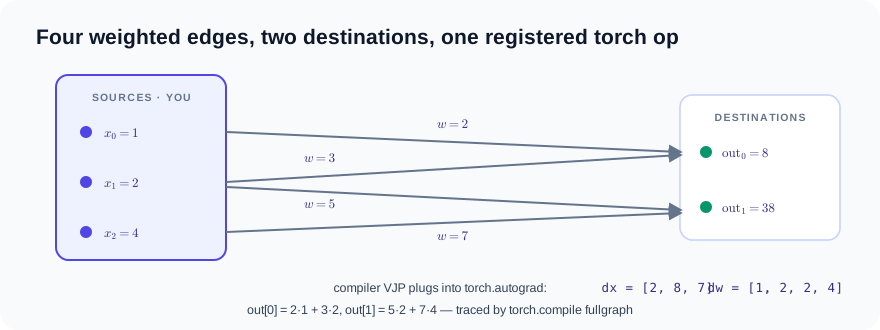
注册是动态且完备的:函数式 dispatcher schema、用于追踪的 FakeTensor/meta
kernel、基于编译器生成 VJP 的自动求导,外加一套 opcheck 测试,都随算子
一并提供;示例随后运行了一次由 Inductor 全图编译的前向/反向。CSR 拓扑是
dispatcher ABI 的一部分,尽管包装器会自动绑定。
class WeightedAggregation(tg.MessagePassing):
    reducer = tg.sum()

    def edge(self, src, dst, edge):
        return edge.weight * src.x


row_ptr = torch.tensor([0, 2, 4], dtype=torch.int64)  # (M+1,)
col_idx = torch.tensor([0, 1, 1, 2], dtype=torch.int64)  # (E,)
graph = tg.Graph.from_csr(row_ptr, col_idx, num_src=3)
x = torch.tensor([1.0, 2.0, 4.0], requires_grad=True)  # (N,)
weight = torch.tensor([2.0, 3.0, 5.0, 7.0], requires_grad=True)  # (E,)

operation = tg.interop.torch.register_message_passing(
    WeightedAggregation(),
    graph=graph,
    src={"x": x},
    dst={},
    edge={"weight": weight},
)


@torch.compile(fullgraph=True)
def model(values, weights):
    return operation(src={"x": values}, dst={}, edge={"weight": weights})


compiled_output = model(x, weight)  # (M,)
完整源码:examples/torch_library.py(可直接运行)
"""Expose one Tiga UDF to torch.compile without a user backward."""

import torch

import tiga as tg


class WeightedAggregation(tg.MessagePassing):
    reducer = tg.sum()

    def edge(self, src, dst, edge):
        return edge.weight * src.x


row_ptr = torch.tensor([0, 2, 4], dtype=torch.int64)  # (M+1,)
col_idx = torch.tensor([0, 1, 1, 2], dtype=torch.int64)  # (E,)
graph = tg.Graph.from_csr(row_ptr, col_idx, num_src=3)
x = torch.tensor([1.0, 2.0, 4.0], requires_grad=True)  # (N,)
weight = torch.tensor([2.0, 3.0, 5.0, 7.0], requires_grad=True)  # (E,)

operation = tg.interop.torch.register_message_passing(
    WeightedAggregation(),
    graph=graph,
    src={"x": x},
    dst={},
    edge={"weight": weight},
)


@torch.compile(fullgraph=True)
def model(values, weights):
    return operation(src={"x": values}, dst={}, edge={"weight": weights})


compiled_output = model(x, weight)  # (M,)

dx, dweight = torch.autograd.grad(compiled_output.sum(), (x, weight))
# out = [2·1 + 3·2,  5·2 + 7·4]
# d x[j] = Σ weight[e] over edges e out of j
# d weight[e] = x[src(e)]
本机编译产物(Ryzen 7 255 · RTX 5070 Ti 实测)
### WeightedAggregationTorchExecutor
backend: cpu
provider: torch.sparse.mm
lowering: dispatch-native-sparse-mm
passes: gf-verify-domain, gf-lower-domain-to-iter, gf-lower-iter-to-kernel, capture-edge-expression, recognize-linear-weighted-sum, dispatch-native-sparse-mm
accepted: [machine-schedule] admitted fixed-row-neighbor
unknown: [pipeline] no compiler-controlled asynchronous pipeline admitted
remark: [planning] no profitable generated specialization was proven; dispatched native sparse library
variant cache: hits=0, misses=1
Edge nn 模块与融合 tile kernel
它是什么。 一个点云网络。三维空间中的 512 个随机点通过半径图连接:
只要点 j 与点 i 的距离不超过 r = 0.15,就存在一条从 j 到 i 的
边。每条边运行一个小型多层感知机(MLP)——线性层、修正线性单元(ReLU)、
线性层——输入是该边的位移向量与源节点特征的拼接,输出一个消息向量。
每个点对其入边上的消息求和。
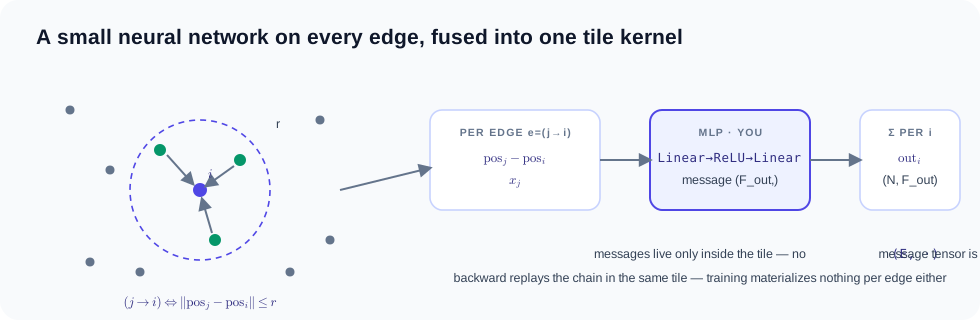
tg.nn.trace 包装一个 torch.nn 模块,让边 UDF 可以调用它:eager 模式下
直接拼接参数并转发给该模块;编译器则会证明整条调用链,生成单个以边为
中心的 tile kernel——不会物化 O(E) 的消息张量。由于 MLP 读取边位移,任何
逐节点预计算都无法外提。梯度模式下的调用沿用同一个融合前向,反向
使用重计算 VJP,因此训练时同样不会物化任何逐边数据。契约与当前限制见
Edge nn 模块。
class EdgeMLP(tg.MessagePassing):
    def __init__(self, mlp):
        super().__init__()
        self.mlp = tg.nn.trace(mlp)  # capturable AND eager-callable

    def edge(self, src, dst, edge):
        # edge.displacement (E, 3), src.x (E, F_in) → message (E, F_out)
        return self.mlp(edge.displacement, src.x)


graph = tg.Graph.radius(positions, cutoff=0.15)  # avg degree ≈ 7
mlp = nn.Sequential(
    nn.Linear(3 + f_in, hidden), nn.ReLU(), nn.Linear(hidden, f_out),
).to(device)
kernel = EdgeMLP(mlp)

with torch.no_grad():
    # Inference takes the compiled fused tile kernel; grad-mode calls take
    # the fused recompute VJP — neither materializes per-edge activations.
    output = kernel(graph=graph, src={"x": x}, dst={})  # (N, F_out)
完整源码:examples/edge_nn_message_passing.py(可直接运行)
"""Edge-local nn modules in MessagePassing with a fused compiler tile kernel."""

import tiga as tg
import torch
from torch import nn

device = "cuda" if torch.cuda.is_available() else "cpu"
torch.manual_seed(0)

nodes, f_in, hidden, f_out = 512, 8, 16, 8
positions = torch.rand((nodes, 3), device=device)        # (N, 3)
x = torch.randn((nodes, f_in), device=device)            # (N, F_in)


class EdgeMLP(tg.MessagePassing):
    def __init__(self, mlp):
        super().__init__()
        self.mlp = tg.nn.trace(mlp)  # capturable AND eager-callable

    def edge(self, src, dst, edge):
        # edge.displacement (E, 3), src.x (E, F_in) → message (E, F_out)
        return self.mlp(edge.displacement, src.x)


graph = tg.Graph.radius(positions, cutoff=0.15)  # avg degree ≈ 7
mlp = nn.Sequential(
    nn.Linear(3 + f_in, hidden), nn.ReLU(), nn.Linear(hidden, f_out),
).to(device)
kernel = EdgeMLP(mlp)

with torch.no_grad():
    # Inference takes the compiled fused tile kernel; grad-mode calls take
    # the fused recompute VJP — neither materializes per-edge activations.
    output = kernel(graph=graph, src={"x": x}, dst={})  # (N, F_out)

# A second architecture through the same UDF: deeper, GELU, bias-free.
mlp2 = nn.Sequential(
    nn.Linear(3 + f_in, hidden, bias=False), nn.GELU(),
    nn.Linear(hidden, hidden), nn.GELU(),
    nn.Linear(hidden, f_out),
).to(device)
kernel2 = EdgeMLP(mlp2)
with torch.no_grad():
    output2 = kernel2(graph=graph, src={"x": x}, dst={})  # (N, F_out)

# Training needs no special casing: grad-mode calls run the same fused tile
# forward, and backward replays per-edge activations inside a recompute VJP
# kernel — no [E, ·] tensor exists in either direction.
xg = x.clone().requires_grad_(True)
output_g = kernel(graph=graph, src={"x": xg}, dst={})
output_g.sum().backward()

# Inspect: kernel.explain(); kernel.last_variant.artifacts["ttir"]
本机编译产物(Ryzen 7 255 · RTX 5070 Ti 实测)
### EdgeMLPTorchExecutor
backend: cuda
provider: triton-nvidia@3.6.0
lowering: gf-python-emit-edge-nn-tile-vjp
passes: capture-edge-nn-subgraph, translate-fx-to-message-dag, prove-edge-nn-tile-structure, python-emit-edge-nn-tile-ttir, symbolic-edge-nn-vjp, python-emit-edge-nn-vjp-ttir, provider-compile-serialized-ttir
provider cache key: triton-nvidia | cuda:nvidia | 3.6.0 | 2.11.0+cu128 | af81e84448f193cc | cuda:120:warp32
remark: [planning] Python emission backend (phase 2); the C++ gf-kernel-to-ttir emitter replaces it in a later phase
remark: [planning] training path: backward recomputes per-edge activations inside the tile; no [E, ·] tensor is materialized in either direction
variant cache: hits=0, misses=2

### EdgeMLPTorchExecutor
backend: cuda
provider: triton-nvidia@3.6.0
lowering: gf-python-emit-edge-nn-tile
passes: capture-edge-nn-subgraph, translate-fx-to-message-dag, prove-edge-nn-tile-structure, python-emit-edge-nn-tile-ttir, provider-compile-serialized-ttir
provider cache key: triton-nvidia | cuda:nvidia | 3.6.0 | 2.11.0+cu128 | af81e84448f193cc | cuda:120:warp32
remark: [planning] Python emission backend (phase 1); the C++ gf-kernel-to-ttir emitter replaces it in a later phase
remark: [planning] edge messages are evaluated inside the tile; no O(E) message tensor is materialized
remark: [planning] inference path; calls that could request gradients take the fused recompute VJP (gf-python-emit-edge-nn-tile-vjp)
variant cache: hits=0, misses=1