Program composition and advanced runtime examples
Ordinary MessagePassing uses Torch directly; see getting started.
The matmul, complex VJP, recurrence and joint-plan examples inspect native Tensor IR
or execution plans, and therefore currently use tg.Tensor. They are not a
replacement for ordinary Torch math. Core snippets omit setup; each expanded
full-source block includes imports and inputs.
Run the source files:
python examples/tensor_matmul.pypython examples/complex_autograd.pypython examples/linear_recurrence.pypython examples/graph_program.pypython examples/joint_autograd.pypython examples/torch_interop.pypython examples/torch_library.pypython examples/edge_nn_message_passing.py
linear_recurrence.py requires CUDA; see each full source for device selection.
Matrix multiplication with derived gradients
Matrix multiplication combines an (M, K) matrix lhs with a (K, N) matrix
rhs into an (M, N) matrix whose entry (i, j) is the dot product of row i of
lhs with column j of rhs. When a scalar loss depends on the output, the
chain rule expresses the gradients of both operands as two further matrix
products with G, the upstream derivative of the loss with respect to the
output (the cotangent).
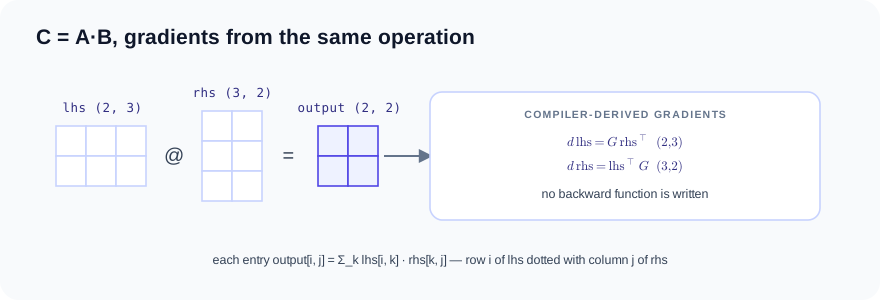
gf_tensor.matmul is a first-class rank-2 contraction. The example lowers it
to CPU LLVM and FP16 GPU tt.dot, and the compiler derives the gradients of
both matrix operands — no backward function is written.
lhs = tg.tensor(
    [[1.0, 2.0, 3.0], [4.0, 5.0, 6.0]], requires_grad=True)  # (M, K)
rhs = tg.tensor(
    [[2.0, 1.0], [0.0, 3.0], [4.0, -1.0]], requires_grad=True)  # (K, N)
cotangent = tg.tensor([[1.0, 2.0], [-1.0, 0.5]])  # (M, N)

output = lhs @ rhs  # (M, N)

dlhs, drhs = tg.autograd.grad(
    output, (lhs, rhs), grad_output=cotangent)
# d loss / d lhs = cotangent @ rhsᵀ
# d loss / d rhs = lhsᵀ @ cotangent
Full source: examples/tensor_matmul.py (runs as-is)
"""Native Tiga Tensor matmul and compiler-derived reverse mode."""

import tiga as tg


lhs = tg.tensor(
    [[1.0, 2.0, 3.0], [4.0, 5.0, 6.0]], requires_grad=True)  # (M, K)
rhs = tg.tensor(
    [[2.0, 1.0], [0.0, 3.0], [4.0, -1.0]], requires_grad=True)  # (K, N)
cotangent = tg.tensor([[1.0, 2.0], [-1.0, 0.5]])  # (M, N)

output = lhs @ rhs  # (M, N)

dlhs, drhs = tg.autograd.grad(
    output, (lhs, rhs), grad_output=cotangent)
# d loss / d lhs = cotangent @ rhsᵀ
# d loss / d rhs = lhsᵀ @ cotangent

# Inspect the semantic Tensor IR: output.mlir()
Measured compilation artifacts (Ryzen 7 255 · RTX 5070 Ti)
### output: Tensor IR (first lines)
module {
  func.func @tensor_main(%arg0: tensor<2x3xf32>, %arg1: tensor<3x2xf32>) -> tensor<2x2xf32> {
    %0 = "gf_tensor.input"(%arg0) <{offset = 0 : i64, strides = array<i64: 3, 1>}> : (tensor<2x3xf32>) -> tensor<2x3xf32>
    %1 = "gf_tensor.input"(%arg1) <{offset = 0 : i64, strides = array<i64: 2, 1>}> : (tensor<3x2xf32>) -> tensor<3x2xf32>
    %2 = "gf_tensor.matmul"(%0, %1) : (tensor<2x3xf32>, tensor<3x2xf32>) -> tensor<2x2xf32>
    return %2 : tensor<2x2xf32>
  }
}
### output: Tensor IR (first lines)
module {
  func.func @tensor_main(%arg0: tensor<2x3xf32>, %arg1: tensor<3x2xf32>) -> tensor<2x2xf32> {
    %0 = "gf_tensor.input"(%arg0) <{offset = 0 : i64, strides = array<i64: 3, 1>}> : (tensor<2x3xf32>) -> tensor<2x3xf32>
    %1 = "gf_tensor.input"(%arg1) <{offset = 0 : i64, strides = array<i64: 2, 1>}> : (tensor<3x2xf32>) -> tensor<3x2xf32>
    %2 = "gf_tensor.matmul"(%0, %1) : (tensor<2x3xf32>, tensor<3x2xf32>) -> tensor<2x2xf32>
    return %2 : tensor<2x2xf32>
  }
}
Complex VJP
Signal-processing and physics workloads often store data as complex numbers a + bi, where i is the imaginary unit. Transposing such a tensor should only change how it is indexed — a zero-copy view — not duplicate memory; a reshape of that non-contiguous view then materializes the elements in view order. Complex outputs also need a convention for differentiation, since ordinary real derivatives do not apply directly: Tiga uses the conjugate- Wirtinger convention, which treats x and its complex conjugate as independent variables and requires an explicit cotangent for complex outputs. Under that convention the squared magnitude |y|² has gradient 2·x.
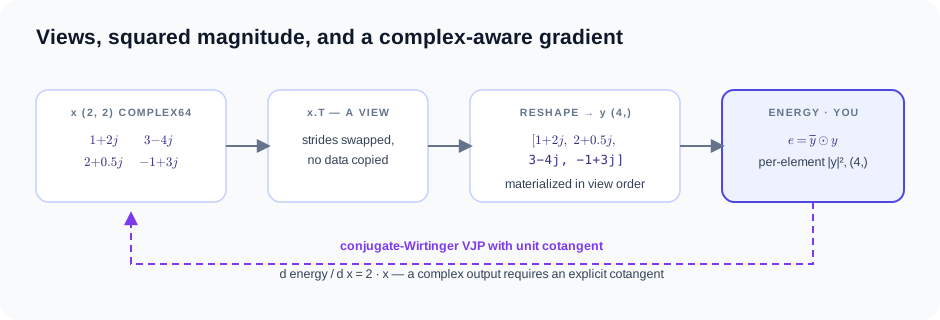
The example exercises complex64 storage, strided zero-copy views and explicit conjugate-Wirtinger cotangents on the native CPU runtime.
x = tg.tensor(
    [[1.0 + 2.0j, 3.0 - 4.0j], [2.0 + 0.5j, -1.0 + 3.0j]],
    requires_grad=True,
)  # (2, 2)

# Transpose is a zero-copy strided view. The following reshape materializes
# logical transpose order because that view is not contiguous.
y = x.T.reshape(-1)  # (4,)

energy_terms = y.conj() * y  # (4,)

# Complex outputs require an explicit cotangent. Tiga uses the
# conjugate-Wirtinger VJP convention.
dx = tg.autograd.grad(
    energy_terms,
    x,
    grad_output=tg.tensor([1.0 + 0.0j] * 4),
)
# d energy_terms / d x = 2x (conjugate-Wirtinger, unit cotangent)
Full source: examples/complex_autograd.py (runs as-is)
"""Complex storage, views and conjugate-Wirtinger VJP."""

import tiga as tg


x = tg.tensor(
    [[1.0 + 2.0j, 3.0 - 4.0j], [2.0 + 0.5j, -1.0 + 3.0j]],
    requires_grad=True,
)  # (2, 2)

# Transpose is a zero-copy strided view. The following reshape materializes
# logical transpose order because that view is not contiguous.
y = x.T.reshape(-1)  # (4,)

energy_terms = y.conj() * y  # (4,)

# Complex outputs require an explicit cotangent. Tiga uses the
# conjugate-Wirtinger VJP convention.
dx = tg.autograd.grad(
    energy_terms,
    x,
    grad_output=tg.tensor([1.0 + 0.0j] * 4),
)
# d energy_terms / d x = 2x (conjugate-Wirtinger, unit cotangent)
Measured compilation artifacts (Ryzen 7 255 · RTX 5070 Ti)
### y: Tensor IR (first lines)
module {
  func.func @tensor_main(%arg0: tensor<2x2xcomplex<f32>>) -> tensor<4xcomplex<f32>> {
    %0 = "gf_tensor.input"(%arg0) <{offset = 0 : i64, strides = array<i64: 2, 1>}> : (tensor<2x2xcomplex<f32>>) -> tensor<2x2xcomplex<f32>>
    %1 = "gf_tensor.permute"(%0) <{axes = array<i64: 1, 0>}> : (tensor<2x2xcomplex<f32>>) -> tensor<2x2xcomplex<f32>>
    %2 = "gf_tensor.reshape"(%1) <{shape = array<i64: 4>}> : (tensor<2x2xcomplex<f32>>) -> tensor<4xcomplex<f32>>
    return %2 : tensor<4xcomplex<f32>>
  }
}
### y: Tensor IR (first lines)
module {
  func.func @tensor_main(%arg0: tensor<2x2xcomplex<f32>>) -> tensor<4xcomplex<f32>> {
    %0 = "gf_tensor.input"(%arg0) <{offset = 0 : i64, strides = array<i64: 2, 1>}> : (tensor<2x2xcomplex<f32>>) -> tensor<2x2xcomplex<f32>>
    %1 = "gf_tensor.permute"(%0) <{axes = array<i64: 1, 0>}> : (tensor<2x2xcomplex<f32>>) -> tensor<2x2xcomplex<f32>>
    %2 = "gf_tensor.reshape"(%1) <{shape = array<i64: 4>}> : (tensor<2x2xcomplex<f32>>) -> tensor<4xcomplex<f32>>
    return %2 : tensor<4xcomplex<f32>>
  }
}
Linear recurrence from map/cumsum/contract
A recurrence produces each output step from the steps before it instead of computing everything at once. This example is causal linear attention, the core of several efficient sequence models: a sequence of S steps where step s contributes a key vector k_s and a value vector v_s, and step t outputs a blend of past values weighted by the similarity of each past key to the current query q_t. "Causal" means step t may only read steps s ≤ t. Folded into a recurrence, a running state accumulates the outer product k_s ⊗ v_s, and each output is a readout of the query against that state.
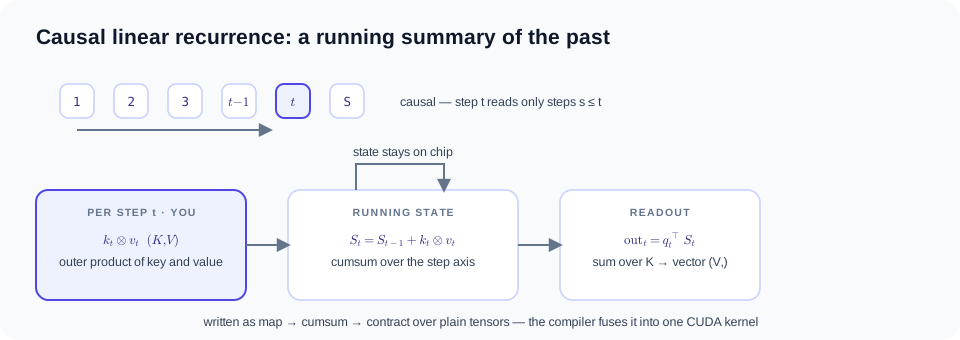
The expression is an ordinary Tensor map/cumsum/contract program — there is no core linear-attention operator. On the registered CUDA shape family the compiler recognizes the map → scan → contract structure and emits one recurrent kernel whose state remains on chip.
state_shape = (lanes, steps, key_width, value_width)  # (L, S, K, V)
updates = (  # (L, S, K, V)
    k.unsqueeze(-1).broadcast_to(state_shape)
    * v.unsqueeze(-2).broadcast_to(state_shape)
)
output = (  # (L, S, V)
    q.unsqueeze(-1).broadcast_to(state_shape) * updates.cumsum(1)
).sum(axis=2)
Full source: examples/linear_recurrence.py (runs as-is)
"""A causal linear recurrence expressed with ordinary Tiga tensors."""

import torch

import tiga as tg


lanes, steps, key_width, value_width = 4, 128, 16, 16
q_torch = torch.randn(lanes, steps, key_width, device="cuda")      # (L, S, K)
k_torch = torch.randn_like(q_torch)                                # (L, S, K)
v_torch = torch.randn(lanes, steps, value_width, device="cuda")    # (L, S, V)
q, k, v = map(tg.from_torch, (q_torch, k_torch, v_torch))

state_shape = (lanes, steps, key_width, value_width)  # (L, S, K, V)
updates = (  # (L, S, K, V)
    k.unsqueeze(-1).broadcast_to(state_shape)
    * v.unsqueeze(-2).broadcast_to(state_shape)
)
output = (  # (L, S, V)
    q.unsqueeze(-1).broadcast_to(state_shape) * updates.cumsum(1)
).sum(axis=2)

actual = output.to_torch()

# Inspect: output.execution, output.generated_code("ttir"), output.expression()
Measured compilation artifacts (Ryzen 7 255 · RTX 5070 Ti)
### output: execution record
backend: cuda-ttir-triton
compile_ms: 553.722441
materialize_ms: 0.0
saved_bytes: 0
saved_compile_ms: 0.0
checkpoint_plan: {'candidate_count': 0, 'delegated_candidate_count': 0, 'decisions': (), 'memory_budget_bytes': -1, 'spill_budget_bytes': 0, 'planned_saved_bytes': 0, 'planned_spilled_bytes': 0, 'actual_spilled_bytes': 0, 'spill_transfer_ms': 0.0, 'tiers': (), 'recompute_costs': (), 'live_intervals': (), 'peak_live_bytes': 0, 'peak_spill_bytes': 0, 'planning_ms': 0.0, 'native_load_ms': 0.0, 'ir': ''}
cache_hit: False
fast_math: False
launch_ms: 0.154881
artifact: triton-cache/034bf974a1da5e8f3e4103ba
source: // tiga.tensor entry=gf_tensor_scan_contract block_rows=1 block_elements=16 num_warps=1 abi=arg0,arg1,arg2,out
module {
  tt.func public @gf_tensor_scan_contract(%arg0: !tt.ptr<f32>, %arg1: !tt.ptr<f32>, %arg2: !tt.ptr<f32>, %out: !tt.ptr<f32>) attributes {noinline = false} {
    %pid_i32 = tt.get_program_id x : i32
    %pid = arith.extui %pid_i32 : i32 to i64
    %value_tiles = arith.constant 1 : i64
    %lane = arith.divui %pid, %value_tiles : i64
    %value_tile = arith.remui %pid, %value_tiles : i64
    %k_i32 = tt.make_range {end = 16 : i32, start = 0 : i32} : tensor<16xi32>
    %v_i32 = tt.make_range {end = 16 : i32, start = 0 : i32} : tensor<16xi32>
    %k_lane = arith.extsi %k_i32 : tensor<16xi32> to tensor<16xi64>
    %v_lane = arith.extsi %v_i32 : tensor<16xi32> to tensor<16xi64>
    %k_bound = arith.constant dense<16> : tensor<16xi64>
    %k_mask = arith.cmpi slt, %k_lane, %k_bound : tensor<16xi64>
    %sixteen = arith.constant 16 : i64
    %v_base = arith.muli %value_tile, %sixteen : i64
    %v_base_vec = tt.splat %v_base : i64 -> tensor<16xi64>
    %v_column = arith.addi %v_base_vec, %v_lane : tensor<16xi64>
    %v_bound = arith.constant dense<16> : tensor<16xi64>
    %v_mask = arith.cmpi slt, %v_column, %v_bound : tensor<16xi64>
    %zero_k = arith.constant dense<0.000000e+00> : tensor<16xf32>
    %zero_v = arith.constant dense<0.000000e+00> : tensor<16xf32>
    %zero_state = arith.constant dense<0.000000e+00> : tensor<16x16xf32>
    %steps_i64 = arith.constant 128 : i64
    %key_width = arith.constant 16 : i64
    %value_width = arith.constant 16 : i64
    %begin = arith.constant 0 : index
    %end = arith.constant 128 : index
    %one = arith.constant 1 : index
    %scan = scf.for %time = %begin to %end step %one iter_args(%state = %zero_state) -> (tensor<16x16xf32>) {
      %time_i64 = arith.index_cast %time : index to i64
      %lane_time_base = arith.muli %lane, %steps_i64 : i64
      %lane_time = arith.addi %lane_time_base, %time_i64 : i64
      %qk_base = arith.muli %lane_time, %key_width : i64
      %qk_base_v = tt.splat %qk_base : i64 -> tensor<16xi64>
      %qk_index = arith.addi %qk_base_v, %k_lane : tensor<16xi64>
      %q_base = tt.splat %arg0 : !tt.ptr<f32> -> tensor<16x!tt.ptr<f32>>
      %k_base = tt.splat %arg1 : !tt.ptr<f32> -> tensor<16x!tt.ptr<f32>>
      %q_ptr = tt.addptr %q_base, %qk_index : tensor<16x!tt.ptr<f32>>, tensor<16xi64>
      %k_ptr = tt.addptr %k_base, %qk_index : tensor<16x!tt.ptr<f32>>, tensor<16xi64>
      %q = tt.load %q_ptr, %k_mask, %zero_k : tensor<16x!tt.ptr<f32>>
      %k = tt.load %k_ptr, %k_mask, %zero_k : tensor<16x!tt.ptr<f32>>
      %value_time_base = arith.muli %lane_time, %value_width : i64
      %value_time_base_v = tt.splat %value_time_base : i64 -> tensor<16xi64>
      %v_index = arith.addi %value_time_base_v, %v_column : tensor<16xi64>
      %v_input_base = tt.splat %arg2 : !tt.ptr<f32> -> tensor<16x!tt.ptr<f32>>
      %v_ptr = tt.addptr %v_input_base, %v_index : tensor<16x!tt.ptr<f32>>, tensor<16xi64>
      %v = tt.load %v_ptr, %v_mask, %zero_v : tensor<16x!tt.ptr<f32>>
      %k2 = tt.expand_dims %k {axis = 1 : i32} : tensor<16xf32> -> tensor<16x1xf32>
      %v2 = tt.expand_dims %v {axis = 0 : i32} : tensor<16xf32> -> tensor<1x16xf32>
      %kb = tt.broadcast %k2 : tensor<16x1xf32> -> tensor<16x16xf32>
      %vb = tt.broadcast %v2 : tensor<1x16xf32> -> tensor<16x16xf32>
      %outer = arith.mulf %kb, %vb : tensor<16x16xf32>
      %next_state = arith.addf %state, %outer : tensor<16x16xf32>
      %q2 = tt.expand_dims %q {axis = 1 : i32} : tensor<16xf32> -> tensor<16x1xf32>
      %qb = tt.broadcast %q2 : tensor<16x1xf32> -> tensor<16x16xf32>
      %weighted = arith.mulf %next_state, %qb : tensor<16x16xf32>
      %partial = "tt.reduce"(%weighted) <{axis = 0 : i32}> ({
      ^bb0(%a: f32, %b: f32):
        %combined = arith.addf %a, %b : f32
        tt.reduce.return %combined : f32
      }) : (tensor<16x16xf32>) -> tensor<16xf32>
      %out_base_scalar = arith.muli %lane_time, %value_width : i64
      %out_base_v = tt.splat %out_base_scalar : i64 -> tensor<16xi64>
      %out_index = arith.addi %out_base_v, %v_column : tensor<16xi64>
      %out_base = tt.splat %out : !tt.ptr<f32> -> tensor<16x!tt.ptr<f32>>
      %out_ptr = tt.addptr %out_base, %out_index : tensor<16x!tt.ptr<f32>>, tensor<16xi64>
      tt.store %out_ptr, %partial, %v_mask : tensor<16x!tt.ptr<f32>>
      scf.yield %next_state : tensor<16x16xf32>
    }
    tt.return
  }
}

ir: module {
  func.func @tensor_main(%arg0: tensor<4x128x16xf32>, %arg1: tensor<4x128x16xf32>, %arg2: tensor<4x128x16xf32>) -> tensor<4x128x16xf32> {
    %0 = "gf_tensor.input"(%arg0) <{offset = 0 : i64, strides = array<i64: 2048, 16, 1>}> : (tensor<4x128x16xf32>) -> tensor<4x128x16xf32>
    %1 = "gf_tensor.reshape"(%0) <{shape = array<i64: 4, 128, 16, 1>}> : (tensor<4x128x16xf32>) -> tensor<4x128x16x1xf32>
    %2 = "gf_tensor.broadcast"(%1) <{shape = array<i64: 4, 128, 16, 16>}> : (tensor<4x128x16x1xf32>) -> tensor<4x128x16x16xf32>
    %3 = "gf_tensor.input"(%arg1) <{offset = 0 : i64, strides = array<i64: 2048, 16, 1>}> : (tensor<4x128x16xf32>) -> tensor<4x128x16xf32>
    %4 = "gf_tensor.reshape"(%3) <{shape = array<i64: 4, 128, 16, 1>}> : (tensor<4x128x16xf32>) -> tensor<4x128x16x1xf32>
    %5 = "gf_tensor.broadcast"(%4) <{shape = array<i64: 4, 128, 16, 16>}> : (tensor<4x128x16x1xf32>) -> tensor<4x128x16x16xf32>
    %6 = "gf_tensor.input"(%arg2) <{offset = 0 : i64, strides = array<i64: 2048, 16, 1>}> : (tensor<4x128x16xf32>) -> tensor<4x128x16xf32>
    %7 = "gf_tensor.reshape"(%6) <{shape = array<i64: 4, 128, 1, 16>}> : (tensor<4x128x16xf32>) -> tensor<4x128x1x16xf32>
    %8 = "gf_tensor.broadcast"(%7) <{shape = array<i64: 4, 128, 16, 16>}> : (tensor<4x128x1x16xf32>) -> tensor<4x128x16x16xf32>
    %9 = "gf_tensor.mul"(%5, %8) : (tensor<4x128x16x16xf32>, tensor<4x128x16x16xf32>) -> tensor<4x128x16x16xf32>
    %10 = "gf_tensor.cumsum"(%9) <{axis = 1 : i64, reverse = false}> : (tensor<4x128x16x16xf32>) -> tensor<4x128x16x16xf32>
    %11 = "gf_tensor.mul"(%2, %10) : (tensor<4x128x16x16xf32>, tensor<4x128x16x16xf32>) -> tensor<4x128x16x16xf32>
    %12 = "gf_tensor.reduce_sum"(%11) <{axes = array<i64: 2>, keep_dims = false}> : (tensor<4x128x16x16xf32>) -> tensor<4x128x16xf32>
    return %12 : tensor<4x128x16xf32>
  }
}

semantic_hash: 034bf974a1da5e8f3e4103baebe98bcd893cb3f4915b121fc16715c99030c4f3
artifacts: {'ttir', 'ttgir', 'llir', 'ptx', 'cubin'}  # ~80 KB of artifacts omitted; full text via kernel.code("ptx")
Cross-kernel SSA capture with @tg.jit
What it is. A weighted graph sum, computed twice. A graph of N = 4096
nodes with E = 16·N edges is stored in compressed sparse row (CSR) format —
one row offset array and one column index array. Each node i sums, over its
incoming edges e = (j→i), the source value x[j] times the edge weight. The
program runs this twice with two different weight vectors w0 and w1, and
returns one (N,) result per weight vector.
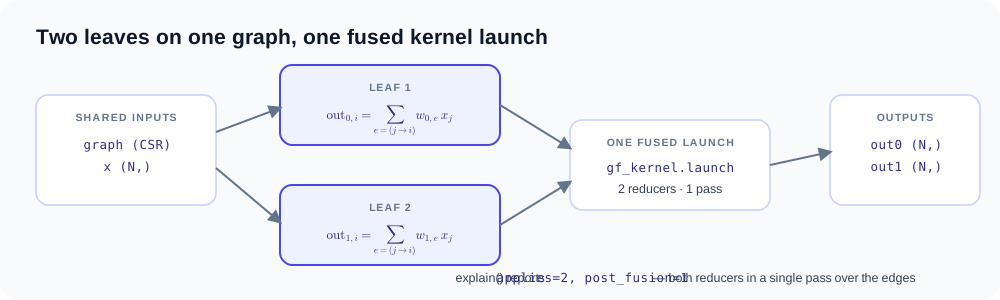
Both WeightedSum calls read the same graph and features, so the @tg.jit
capture registers them as typed static single assignment (SSA) leaves and
fuses them horizontally into a single gf_kernel.launch carrying two
reducers — explain() reports applies=2, post_fusion=1. There is no
explicit compile call: the first observation triggers just-in-time (JIT)
compilation, and the Kernel IR and PTX (NVIDIA GPU assembly) stay
inspectable. This first executable provider example uses the Torch
adapter for CUDA storage.
Just @tg.jit: loop capture and cross-kernel fusion are both automatic.
@tg.jit rewrites for/while loops into gf_control.repeat /
gf_control.while regions and activates the program context, so every
MessagePassing apply in the straight-line body becomes a typed SSA leaf
that can fuse across kernel boundaries. Loop bodies keep per-iteration
semantics: a kernel call inside a staged region inlines into the loop body
instead of registering as a top-level leaf, and an SSA leaf participates in
tensor arithmetic directly, so a Picard-style state + apply(state) loop
composes under @tg.jit — stacked with @tg.program or not. @tg.program
remains as a compatibility entry point for straight-line code that cannot
offer source access: it activates the same context without AST rewriting.
Autograd composes through the boundary: a leaf is differentiable when any captured field requires gradients, and reverse mode re-expands each leaf's kernel inline — per leaf, unfused, while the forward keeps the fused launch. Leaves sharing one input accumulate their gradient contributions; leaf forms without an inline differentiable expansion (provider-owned fields, relation realizations outside the native set) fail closed with a clear error rather than a silent wrong gradient.
class WeightedSum(tg.MessagePassing):
    reducer = tg.sum()

    def edge(self, src, dst, edge):
        return src.x * edge.weight


# Regular degree-16 relation: dst i gathers from sources (i*degree + k) % N.
graph = tg.Graph.regular(nodes, degree, device=device)


@tg.jit
def two_observables():
    # @tg.jit captures the two sibling kernel calls automatically; there is
    # no explicit gf.compile() and no separate composition decorator.
    return (
        WeightedSum()(graph=graph, src={"x": x}, dst={},
                      edge={"weight": w0}),  # (N,)
        WeightedSum()(graph=graph, src={"x": x}, dst={},
                      edge={"weight": w1}),  # (N,)
    )


first, second = two_observables()
# The two leaves are planned as one fused kernel launch.
Full source: examples/graph_program.py (runs as-is)
"""Automatic horizontal fusion across two MessagePassing leaf calls."""

import torch

import tiga as tg

device = "cuda" if torch.cuda.is_available() else "cpu"
nodes, degree = 4096, 16
x = torch.randn(nodes, device=device)                                        # (N,)
w0 = torch.randn(nodes * degree, device=device)                              # (E,)
w1 = torch.randn(nodes * degree, device=device)                              # (E,)


class WeightedSum(tg.MessagePassing):
    reducer = tg.sum()

    def edge(self, src, dst, edge):
        return src.x * edge.weight


# Regular degree-16 relation: dst i gathers from sources (i*degree + k) % N.
graph = tg.Graph.regular(nodes, degree, device=device)


@tg.jit
def two_observables():
    # @tg.jit captures the two sibling kernel calls automatically; there is
    # no explicit gf.compile() and no separate composition decorator.
    return (
        WeightedSum()(graph=graph, src={"x": x}, dst={},
                      edge={"weight": w0}),  # (N,)
        WeightedSum()(graph=graph, src={"x": x}, dst={},
                      edge={"weight": w1}),  # (N,)
    )


first, second = two_observables()
# The two leaves are planned as one fused kernel launch.

if device == "cuda":
    out0, out1 = first.program.run()  # observation triggers JIT

# Inspect: first.program.explain(), first.program.ir("kernel"),
#          first.program.code("ptx")
Measured compilation artifacts (Ryzen 7 255 · RTX 5070 Ti)
### WeightedSumTorchExecutor  (leaf 0 of 2 — identical for leaf 1)
backend: cpu
provider: torch.sparse.mm
lowering: dispatch-native-sparse-mm
passes: gf-verify-domain, gf-lower-domain-to-iter, gf-lower-iter-to-kernel, capture-edge-expression, recognize-linear-weighted-sum, dispatch-native-sparse-mm
remark: [planning] no profitable generated specialization was proven; dispatched native sparse library
# no fused product kernel exists off CUDA: each apply runs as an
# ordinary kernel; the fusion stays an IR-level plan.
Joint forward/backward DAG
What it is. Reverse-mode automatic differentiation on a tiny function.
Given the vector x = [2, 3], the program computes a loss — the sum of the
squared entries — and the gradient of that loss with respect to x. The
gradient pass is a vector–Jacobian product (VJP): it propagates the scalar
loss derivative backward through each operation to every input, here reducing
to the rule "derivative of x² is 2x".
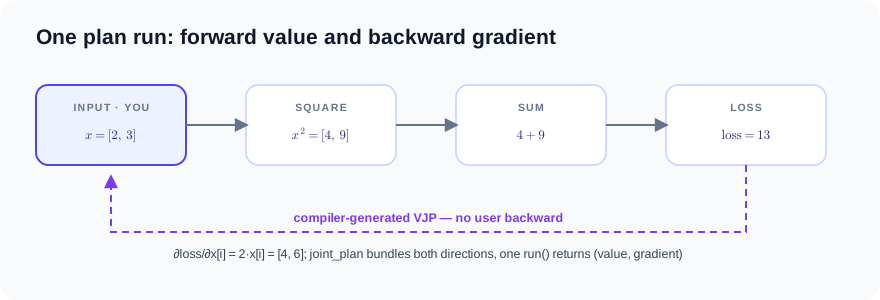
tg.autograd.joint_plan bundles the forward and the compiler-derived VJP into
one inspectable dependency DAG with automatic checkpointing; a single
plan.run() returns both value and gradient — no user-written backward.
The plan is storage-agnostic: torch storage enters through tg.from_torch
(zero-copy), and results return with .to_torch(copy=True) — one copy on
the way out only, because the results are computed by Tiga rather than
wrapped from torch.
xt = torch.tensor([2.0, 3.0], requires_grad=True)  # (2,) torch storage
x = tg.from_torch(xt, requires_grad=True)          # zero-copy into tg.Tensor
loss = (x * x).sum()                               # scalar deferred DAG
plan = tg.autograd.joint_plan(loss, x, checkpoint="auto")
value, dx = plan.run()
# loss = 2² + 3² = 13; dx = 2x = [4, 6]
dx.to_torch(copy=True)  # gf-computed results: one copy back out
Full source: examples/joint_autograd.py (runs as-is)
"""One inspectable execution DAG for forward and compiler-generated VJP."""

import torch

import tiga as tg

xt = torch.tensor([2.0, 3.0], requires_grad=True)  # (2,) torch storage
x = tg.from_torch(xt, requires_grad=True)          # zero-copy into tg.Tensor
loss = (x * x).sum()                               # scalar deferred DAG
plan = tg.autograd.joint_plan(loss, x, checkpoint="auto")
value, dx = plan.run()
# loss = 2² + 3² = 13; dx = 2x = [4, 6]
dx.to_torch(copy=True)  # gf-computed results: one copy back out

# Inspect: plan.explain()  — forward/backward executable bundle summary
Measured compilation artifacts (Ryzen 7 255 · RTX 5070 Ti)
### plan: JointAutogradPlan
executable bundle: invocations=2 snapshot=0
structure hash: 61e2b07488ff42fc
bindings: output, gradient:0
  forward (autograd-forward) <- ready; output:write
  backward:0 (autograd-backward) <- forward; output:read, gradient:0:write
checkpoint/spill decisions are consumed while each backward executable is physicalized

### dx: execution record
backend: python-oracle
native_error: None

### loss: execution record
backend: python-oracle
native_error: None

### value: execution record
backend: python-oracle
native_error: None
### plan: JointAutogradPlan
executable bundle: invocations=2 snapshot=0
structure hash: 61e2b07488ff42fc
bindings: output, gradient:0
  forward (autograd-forward) <- ready; output:write
  backward:0 (autograd-backward) <- forward; output:read, gradient:0:write
checkpoint/spill decisions are consumed while each backward executable is physicalized

### dx: execution record
backend: python-oracle
native_error: None

### loss: execution record
backend: python-oracle
native_error: None

### value: execution record
backend: python-oracle
native_error: None
Default Torch interface and optional native storage bridge
What it is. Neighbor summation on a ring, plus storage sharing. Eight
nodes form a ring: each node has exactly two incoming edges, one from each
adjacent node, with unit weights — so every node's output is the sum of its
two neighbors' values. Separately, a native tg.Tensor is created from the
Torch tensor and converted back, sharing the same underlying storage both
ways.
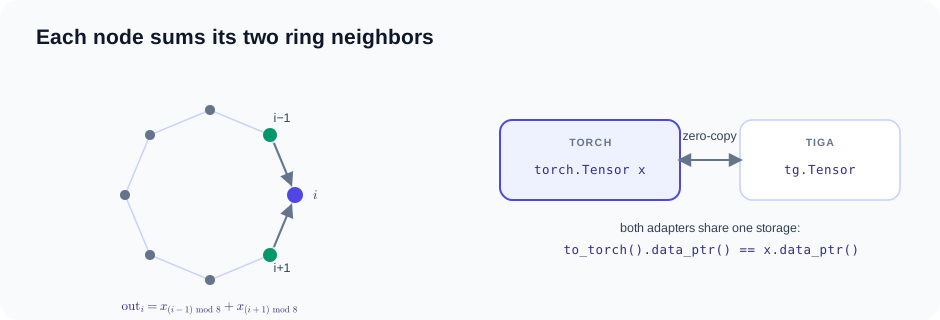
Torch tensors call the MessagePassing UDF directly — no conversion, no
copy; Torch is installed separately, not by the default Tiga installation. The low-level native compiler and runtime
remain independently usable. The
tg.from_torch/to_torch pair is only for the other direction — entering
the native tg.Tensor system (deferred capture, compiler VJP) while still
sharing torch storage — confirmed by an identical data pointer. Currently, native structured-control-flow capture requires this conversion: a @tg.jit loop and the
linear_solve / nonlinear_solve drivers reify their iteration as
gf_control.repeat / gf_control.while, so their vectors must be
tg.Tensor (passing a torch tensor there raises TypeError). The lazy JIT
object exposes the verified, provider-neutral machine schedule selected by
gf.kernel.
class WeightedAggregation(tg.MessagePassing):
    reducer = tg.sum()

    def edge(self, src, dst, edge):
        return edge.weight * src.x


# Ring adjacency with unit weights: out[i] = x[(i-1) mod N] + x[(i+1) mod N].
row_ptr = torch.arange(0, nodes * degree + 1, degree, dtype=torch.int64)  # (N+1,)
col_idx = (  # (E,)
    torch.arange(nodes)[:, None] + torch.tensor([-1, 1])
).remainder(nodes).flatten()

# Torch tensors call the UDF directly — no conversion, no copy.
graph = tg.Graph.from_csr(row_ptr, col_idx, num_src=nodes, validate="full")
kernel = WeightedAggregation()
output = kernel(  # (N,)
    graph=graph, src={"x": x}, dst={}, edge={"weight": weight})
Full source: examples/torch_interop.py (runs as-is)
"""Default Torch interface, plus an optional native-storage round trip."""

import torch

import tiga as tg

nodes, degree = 8, 2
x = torch.linspace(0, 1, nodes)                                            # (N,)
weight = torch.ones(nodes * degree)                                        # (E,)


class WeightedAggregation(tg.MessagePassing):
    reducer = tg.sum()

    def edge(self, src, dst, edge):
        return edge.weight * src.x


# Ring adjacency with unit weights: out[i] = x[(i-1) mod N] + x[(i+1) mod N].
row_ptr = torch.arange(0, nodes * degree + 1, degree, dtype=torch.int64)  # (N+1,)
col_idx = (  # (E,)
    torch.arange(nodes)[:, None] + torch.tensor([-1, 1])
).remainder(nodes).flatten()

# Torch tensors call the UDF directly — no conversion, no copy.
graph = tg.Graph.from_csr(row_ptr, col_idx, num_src=nodes, validate="full")
kernel = WeightedAggregation()
output = kernel(  # (N,)
    graph=graph, src={"x": x}, dst={}, edge={"weight": weight})

# from_torch/to_torch are NOT required for the call above. They exist for the
# other direction: entering the native tg.Tensor system (deferred expression
# capture, compiler-generated VJP) while still sharing torch storage.
native = tg.from_torch(x)
round_trip = native.to_torch()  # same storage, zero copy

# Inspect: kernel.explain(), kernel.schedules
#          (schedule.resources, schedule.roles, schedule.instructions)
Measured compilation artifacts (Ryzen 7 255 · RTX 5070 Ti)
### WeightedAggregationTorchExecutor
backend: cpu
provider: torch.sparse.mm
lowering: dispatch-native-sparse-mm
passes: gf-verify-domain, gf-lower-domain-to-iter, gf-lower-iter-to-kernel, capture-edge-expression, recognize-linear-weighted-sum, dispatch-native-sparse-mm
accepted: [machine-schedule] admitted fixed-row-neighbor
unknown: [pipeline] no compiler-controlled asynchronous pipeline admitted
remark: [planning] no profitable generated specialization was proven; dispatched native sparse library
variant cache: hits=0, misses=1
### WeightedAggregationTorchExecutor
backend: cuda
provider: triton-nvidia@3.6.0
lowering: gf-kernel-to-ttir-fixed-csr-weighted-sum
passes: gf-verify-domain, gf-lower-domain-to-iter, gf-lower-iter-to-kernel, capture-edge-expression, recognize-linear-weighted-sum, analyze-fixed-degree, select-fixed-row-neighbor-tile, gf-kernel-to-ttir, provider-compile-serialized-ttir
provider cache key: triton-nvidia | cuda:nvidia | 3.6.0 | 2.11.0+cu128 | af81e84448f193cc | cuda:120:warp32
accepted: [machine-schedule] admitted fixed-row-neighbor
unknown: [pipeline] no compiler-controlled asynchronous pipeline admitted
remark: [planning] physical fixed-degree proof selected a row-neighbor-feature tile
remark: [planning] TTIR was emitted from gf_kernel IR without a @triton.jit frontend
remark: [planning] the direct candidate passed the SOTA runtime gate on this machine
remark: [planning] frozen CSR indices remain bound to the compiled executable
variant cache: hits=0, misses=1
torch.library registration
What it is. A weighted sum over a tiny bipartite graph: three source nodes
with values [1, 2, 4], two destination nodes, and four weighted edges
(0→0, 1→0, 1→1, 2→1). Each destination sums weight · source value
over its incoming edges. The UDF is then registered as a native Torch
operator, so torch.compile can trace it inside a model and torch.autograd
can differentiate through it.
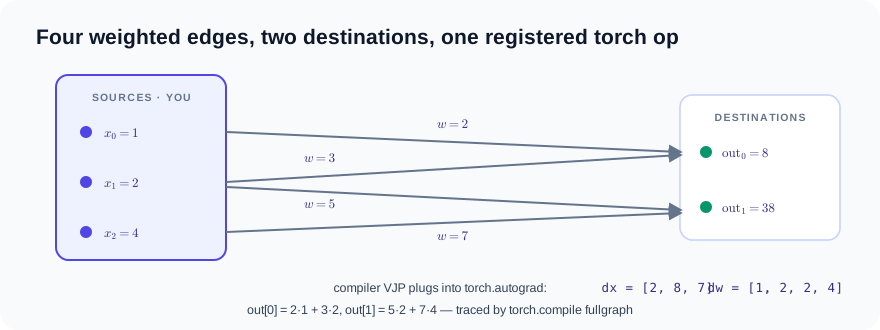
Registration is dynamic and exact: a functional dispatcher schema, a
FakeTensor/meta kernel for tracing, automatic autograd via the
compiler-generated VJP, and an opcheck suite all come with the op; the
example then runs a full-graph Inductor-compiled forward/backward. The CSR
topology is part of the dispatcher ABI even though the wrapper binds it
automatically.
class WeightedAggregation(tg.MessagePassing):
    reducer = tg.sum()

    def edge(self, src, dst, edge):
        return edge.weight * src.x


row_ptr = torch.tensor([0, 2, 4], dtype=torch.int64)  # (M+1,)
col_idx = torch.tensor([0, 1, 1, 2], dtype=torch.int64)  # (E,)
graph = tg.Graph.from_csr(row_ptr, col_idx, num_src=3)
x = torch.tensor([1.0, 2.0, 4.0], requires_grad=True)  # (N,)
weight = torch.tensor([2.0, 3.0, 5.0, 7.0], requires_grad=True)  # (E,)

operation = tg.interop.torch.register_message_passing(
    WeightedAggregation(),
    graph=graph,
    src={"x": x},
    dst={},
    edge={"weight": weight},
)


@torch.compile(fullgraph=True)
def model(values, weights):
    return operation(src={"x": values}, dst={}, edge={"weight": weights})


compiled_output = model(x, weight)  # (M,)
Full source: examples/torch_library.py (runs as-is)
"""Expose one Tiga UDF to torch.compile without a user backward."""

import torch

import tiga as tg


class WeightedAggregation(tg.MessagePassing):
    reducer = tg.sum()

    def edge(self, src, dst, edge):
        return edge.weight * src.x


row_ptr = torch.tensor([0, 2, 4], dtype=torch.int64)  # (M+1,)
col_idx = torch.tensor([0, 1, 1, 2], dtype=torch.int64)  # (E,)
graph = tg.Graph.from_csr(row_ptr, col_idx, num_src=3)
x = torch.tensor([1.0, 2.0, 4.0], requires_grad=True)  # (N,)
weight = torch.tensor([2.0, 3.0, 5.0, 7.0], requires_grad=True)  # (E,)

operation = tg.interop.torch.register_message_passing(
    WeightedAggregation(),
    graph=graph,
    src={"x": x},
    dst={},
    edge={"weight": weight},
)


@torch.compile(fullgraph=True)
def model(values, weights):
    return operation(src={"x": values}, dst={}, edge={"weight": weights})


compiled_output = model(x, weight)  # (M,)

dx, dweight = torch.autograd.grad(compiled_output.sum(), (x, weight))
# out = [2·1 + 3·2,  5·2 + 7·4]
# d x[j] = Σ weight[e] over edges e out of j
# d weight[e] = x[src(e)]
Measured compilation artifacts (Ryzen 7 255 · RTX 5070 Ti)
### WeightedAggregationTorchExecutor
backend: cpu
provider: torch.sparse.mm
lowering: dispatch-native-sparse-mm
passes: gf-verify-domain, gf-lower-domain-to-iter, gf-lower-iter-to-kernel, capture-edge-expression, recognize-linear-weighted-sum, dispatch-native-sparse-mm
accepted: [machine-schedule] admitted fixed-row-neighbor
unknown: [pipeline] no compiler-controlled asynchronous pipeline admitted
remark: [planning] no profitable generated specialization was proven; dispatched native sparse library
variant cache: hits=0, misses=1
Edge nn modules with a fused tile kernel
What it is. A point-cloud network. 512 random points in 3D space are
connected by a radius graph: point j has an edge to point i whenever their
distance is at most r = 0.15. Every edge runs a small multi-layer perceptron
(MLP) — linear layer, rectified linear unit (ReLU), linear layer — on the
edge's displacement vector concatenated with the source node's features,
producing a message vector. Each point sums the messages on its incoming
edges.
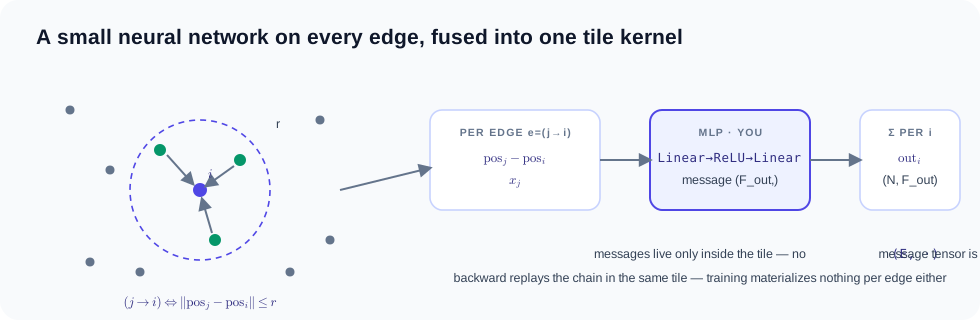
tg.nn.trace wraps a torch.nn module so an edge UDF can call it: eager
execution concatenates the arguments and forwards them to the module, while
the compiler proves the chain and emits one edge-centric tile kernel — no
O(E) message tensor is materialized. Because the MLP reads the edge
displacement, no node-wise precompute can hoist it. Grad-mode calls take the
same fused forward and a recompute-VJP backward, so training materializes
nothing per edge either. See
Edge nn modules
for the contract and current limits.
class EdgeMLP(tg.MessagePassing):
    def __init__(self, mlp):
        super().__init__()
        self.mlp = tg.nn.trace(mlp)  # capturable AND eager-callable

    def edge(self, src, dst, edge):
        # edge.displacement (E, 3), src.x (E, F_in) → message (E, F_out)
        return self.mlp(edge.displacement, src.x)


graph = tg.Graph.radius(positions, cutoff=0.15)  # avg degree ≈ 7
mlp = nn.Sequential(
    nn.Linear(3 + f_in, hidden), nn.ReLU(), nn.Linear(hidden, f_out),
).to(device)
kernel = EdgeMLP(mlp)

with torch.no_grad():
    # Inference takes the compiled fused tile kernel; grad-mode calls take
    # the fused recompute VJP — neither materializes per-edge activations.
    output = kernel(graph=graph, src={"x": x}, dst={})  # (N, F_out)
Full source: examples/edge_nn_message_passing.py (runs as-is)
"""Edge-local nn modules in MessagePassing with a fused compiler tile kernel."""

import tiga as tg
import torch
from torch import nn

device = "cuda" if torch.cuda.is_available() else "cpu"
torch.manual_seed(0)

nodes, f_in, hidden, f_out = 512, 8, 16, 8
positions = torch.rand((nodes, 3), device=device)        # (N, 3)
x = torch.randn((nodes, f_in), device=device)            # (N, F_in)


class EdgeMLP(tg.MessagePassing):
    def __init__(self, mlp):
        super().__init__()
        self.mlp = tg.nn.trace(mlp)  # capturable AND eager-callable

    def edge(self, src, dst, edge):
        # edge.displacement (E, 3), src.x (E, F_in) → message (E, F_out)
        return self.mlp(edge.displacement, src.x)


graph = tg.Graph.radius(positions, cutoff=0.15)  # avg degree ≈ 7
mlp = nn.Sequential(
    nn.Linear(3 + f_in, hidden), nn.ReLU(), nn.Linear(hidden, f_out),
).to(device)
kernel = EdgeMLP(mlp)

with torch.no_grad():
    # Inference takes the compiled fused tile kernel; grad-mode calls take
    # the fused recompute VJP — neither materializes per-edge activations.
    output = kernel(graph=graph, src={"x": x}, dst={})  # (N, F_out)

# A second architecture through the same UDF: deeper, GELU, bias-free.
mlp2 = nn.Sequential(
    nn.Linear(3 + f_in, hidden, bias=False), nn.GELU(),
    nn.Linear(hidden, hidden), nn.GELU(),
    nn.Linear(hidden, f_out),
).to(device)
kernel2 = EdgeMLP(mlp2)
with torch.no_grad():
    output2 = kernel2(graph=graph, src={"x": x}, dst={})  # (N, F_out)

# Training needs no special casing: grad-mode calls run the same fused tile
# forward, and backward replays per-edge activations inside a recompute VJP
# kernel — no [E, ·] tensor exists in either direction.
xg = x.clone().requires_grad_(True)
output_g = kernel(graph=graph, src={"x": xg}, dst={})
output_g.sum().backward()

# Inspect: kernel.explain(); kernel.last_variant.artifacts["ttir"]
Measured compilation artifacts (Ryzen 7 255 · RTX 5070 Ti)
### EdgeMLPTorchExecutor
backend: cuda
provider: triton-nvidia@3.6.0
lowering: gf-python-emit-edge-nn-tile-vjp
passes: capture-edge-nn-subgraph, translate-fx-to-message-dag, prove-edge-nn-tile-structure, python-emit-edge-nn-tile-ttir, symbolic-edge-nn-vjp, python-emit-edge-nn-vjp-ttir, provider-compile-serialized-ttir
provider cache key: triton-nvidia | cuda:nvidia | 3.6.0 | 2.11.0+cu128 | af81e84448f193cc | cuda:120:warp32
remark: [planning] Python emission backend (phase 2); the C++ gf-kernel-to-ttir emitter replaces it in a later phase
remark: [planning] training path: backward recomputes per-edge activations inside the tile; no [E, ·] tensor is materialized in either direction
variant cache: hits=0, misses=2

### EdgeMLPTorchExecutor
backend: cuda
provider: triton-nvidia@3.6.0
lowering: gf-python-emit-edge-nn-tile
passes: capture-edge-nn-subgraph, translate-fx-to-message-dag, prove-edge-nn-tile-structure, python-emit-edge-nn-tile-ttir, provider-compile-serialized-ttir
provider cache key: triton-nvidia | cuda:nvidia | 3.6.0 | 2.11.0+cu128 | af81e84448f193cc | cuda:120:warp32
remark: [planning] Python emission backend (phase 1); the C++ gf-kernel-to-ttir emitter replaces it in a later phase
remark: [planning] edge messages are evaluated inside the tile; no O(E) message tensor is materialized
remark: [planning] inference path; calls that could request gradients take the fused recompute VJP (gf-python-emit-edge-nn-tile-vjp)
variant cache: hits=0, misses=1