Memory hierarchy and distributed execution
Ordinary programs use memory and storage. This page describes the compiler-facing memory hierarchy and distributed execution mechanisms.
Current boundary
Native-Tensor LRU eviction, compiler physical instances and graph paging have separate ownership and budgets. CUDA paging supports FP32 forward with host staging and a resident output; backward is CPU-only. Distributed TCP/NCCL execution supports forward/VJP and completes communication before computation. See the support matrix for coverage and performance measurements for workload results.
Memory hierarchy
A logical value may have several explicitly managed physical instances. HierarchyRuntime tracks their logical name, version, capacity and completion; it does not automatically turn every public Tensor into such an instance.
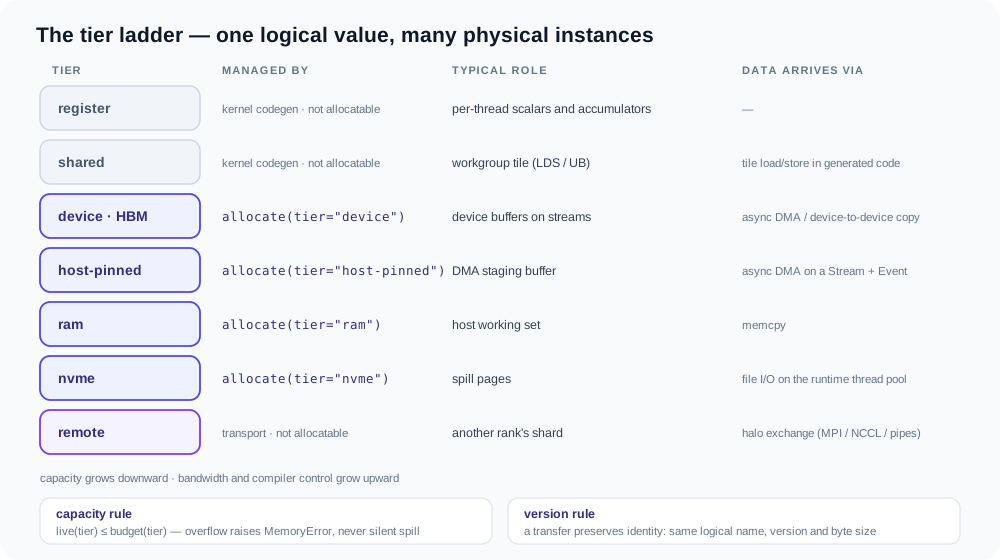
Register/shared storage belongs to generated kernels. device, host-pinned, ram and nvme are runtime-allocatable. remote denotes transport-managed data, not a locally allocatable buffer.
Capacity and version accounting
An instance allocation checks its runtime's per-tier budget. Native buffers and temporary NVMe instances also participate in an active tg.execution budget; these are distinct checks, not twice the allocation. Capacity counts live allocations, not process RSS.
A transfer requires matching logical name, version and capacity. Its completion is available through .ready / .wait(). Closing a source waits for outstanding readers before releasing its bytes; writing a destination also waits for its previous readers. latest(name) selects the highest live version; equal-version copies have no implied preferred tier.
This complete CPU example moves eight bytes through an NVMe instance and verifies the round trip:
import tiga as tg

with tg.runtime.HierarchyRuntime(budgets={"ram": 16, "nvme": 8}) as rt:
    hot = rt.allocate("state", 7, tier="ram", capacity_bytes=8)
    hot.buffer.write(b"tiga1234")
    cold = rt.allocate("state", 7, tier="nvme", capacity_bytes=8)
    rt.transfer(hot, cold).wait()
    hot.close()
    back = rt.allocate("state", 7, tier="ram", capacity_bytes=8)
    rt.transfer(cold, back).wait()
    assert back.buffer.read() == b"tiga1234"
The runtime context owns these physical instances and closes them on exit. In contrast, an execution policy context does not invalidate returned public Tensors. RAM↔NVMe file copies use bounded chunks, and device copies use native stream/event ordering. No compiler automatically inserts all necessary spill/reload decisions for an arbitrary program.
Compiler bundle plans
Above this runtime sits the compiler's physical plan: an
ExecutableBundlePlan is a validated DAG of invocations plus
ResourceRequirements (name, memory space, capacity, snapshot version).
allocate_hierarchy(runtime) maps requirements onto tier instances, and three
reserved symbols give the plan explicit storage control: __gf_transfer
(a tier move), __gf_release (an instance close) and __gf_join.
The legality rule is worth stating plainly: every write/write or read/write conflict must be ordered by an explicit dependency unless two accesses are proven disjoint through the same partitioning — the runtime never invents a dependency. A bundle that violates this is rejected at construction, not debugged after a corrupt run.
Distributed execution
A distributed graph is still an ordinary Graph. graph.halo(mesh, ...)
attaches declarative placement — no data moves, no subtype appears:
mesh = tg.DeviceMesh("cuda", (2, 4), names=("rack", "gpu"))
graph = graph.halo(mesh, partition=tg.ByDestination(mesh_axis="gpu"), depth="auto")
Ownership and ghosts, exactly
With N destination entities and W ranks, the default balanced partition
gives rank r the contiguous row range
and the ghost set is derived from the relation, not declared:
derive_halo_map computes this per rank from owned CSR rows alone; for a paged
.gfg store each rank reads only its own row range, so no rank ever
materializes the global adjacency.
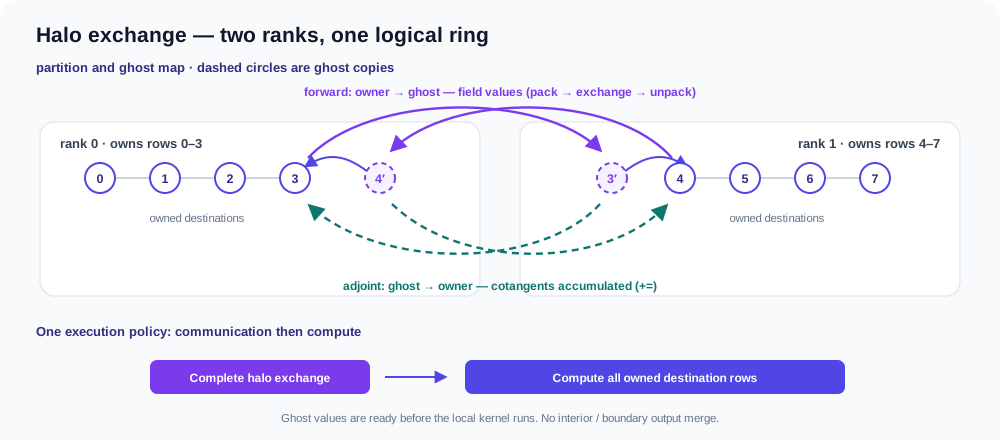
Forward: communication then compute
Distributed forward execution follows this sequence:
- Pack and exchange halo values from owner to ghost.
- Wait for the received source values to be ready.
- Compute all owned destination rows in one local call.
All owned rows write to one local output. The graph and edge function do not require a scheduling option. CPU, MPI, TCP and NCCL follow the same dependency order; transport selection only changes data movement.
Every call records DistributedRuntime.last_execution_trace (schema
tiga.distributed-execution-trace.v1). Its schedule is
host-staged-serialized or device-direct-serialized, with
interior_rows=0 and measured_overlap_ms=0.
Backward: the adjoint is also a halo exchange
The forward pass wraps each combined source field as a
distributed_halo_snapshot leaf, so the generated VJP knows the reverse
communication pattern without any user code: ghost cotangents are sent back to
their owners and accumulated into the owned rows —
which is exactly the adjoint of the forward owner→ghost gather. The distributed halo example verifies this end to end on an 8-node ring: each rank's local gradient is uniformly 3, including the contributions that cross the rank boundary.
Two-host CUDA sanity check
multi_host_gpu_gate.py checks forward, VJP and repeated calls with changed inputs on both ranks. Run from each host's repository root:
# Host A: substitute A's reachable private address.
PYTHONPATH=python python benchmarks/distributed/multi_host_gpu_gate.py \
  --rank 0 --host 192.168.1.10 --port 29570 --device cuda:0 --output output/rank0.json

# Host B: connect to A; both hosts can use local device cuda:0.
PYTHONPATH=python python benchmarks/distributed/multi_host_gpu_gate.py \
  --rank 1 --host 192.168.1.10 --port 29570 --device cuda:0 --output output/rank1.json
Both files must report correct=true. Matching source, built compiler tools,
and compatible Triton and CUDA are required; GPU architectures can differ.
Global rank identifies the participating process; the local CUDA ordinal
selects its GPU. See distributed performance measurements
for latency across partition sizes.
Halo derivation and communication-then-compute execution are automatic, not host discovery, remote process launch or GPU-speed-aware load balancing. TCP stages through host memory, not NCCL/GPU-direct. Object messages use pickle: connect trusted private peers only. timeout bounds connection and data waits; allow sufficient cold-JIT time. A full mesh with more than two ranks requires reachable peer listening ports.
NCCL on two hosts
Use --transport nccl to check graph forward, VJP and repeated calls on the
NCCL path. Startup distributes the communicator ID over TCP; NCCL then
exchanges device buffers. For a standalone bidirectional 1 MiB exchange, run
the NCCL probe.
The following command selects Socket communication. Replace INTERFACE with
a network interface reachable by both hosts and HOST with rank 0's address:
# Run on each host with distinct RANK=0/1 and a shared reachable HOST.
NCCL_SOCKET_IFNAME=INTERFACE NCCL_SOCKET_FAMILY=AF_INET NCCL_IB_DISABLE=1 \
  PYTHONPATH=python timeout 90s python benchmarks/distributed/multi_host_gpu_gate.py \
  --rank RANK --host HOST --port 29659 --transport nccl --output rank-RANK.json
Both records must report correct=true and agree on source and NCCL library
hashes. Use a launcher timeout to bound initialization waits and expose
transport ports only to trusted peers.
Runtimes and transports
Communication is a runtime stage, separate from local kernel compilation. CPU halo VJP materializes its cotangent, exchanges contributions, then exposes the result as an input to the next LLVM-compiled operation, including in strict native mode. The active runtime must outlive gradient realization.
Bind a runtime
Execution requires an active runtime; calling a distributed graph without one
fails closed (NotImplementedError):
with tg.distributed.DistributedRuntime(transport):
    out = Diffusion()(graph=graph, src={"u": local_u}, dst={"u": local_u})
Transports are deployment plugins selected at process initialization — kernel and graph code never name one:
PipeTransport— stdlibmultiprocessingpipes (used by the example and the two-process tests);TCPTransport/from_provider("tcp")— dependency-free cross-machine transport over plain sockets (rendezvous, rank handshake, framed streams);DistributedRuntime.from_provider("mpi")— a thin mpi4py wrapper;from_provider("nccl", rank=..., world_size=..., communicator_id=..., ...)binds a reallibncclcommunicator (grouped send/recv only; rank 0 creates the 128-bytencclUniqueId, the launcher broadcasts it);- third parties register through the
tiga.transportentry-point group.
Persistent topology keeps the same API: tg.save(graph, "mesh.gfg") writes a
versioned paged store (manifest + row_ptr.bin + col_idx.bin), and
tg.load("mesh.gfg").halo(mesh, depth="auto") returns to the same partitioned
snapshot with each rank reading only its own pages. tg.load reads the
manifest only; resolve_csr() remains an explicit debug materialization.
Measured transfer, halo-exchange, overlap and NCCL evidence for these paths is collected on the benchmark results page.