Reducers
Prerequisite: Programming model. A reducer specifies how messages arriving at one destination combine. Start with a built-in; the custom algebra below is needed only when built-ins cannot express the computation.
Choose a built-in reducer
| Desired result | Choice | Important behavior |
|---|---|---|
| Sum of messages | tg.sum() |
An empty row produces 0 by default |
| Mean of messages | tg.mean() |
An empty row produces NaN, not automatically 0 |
| Product of messages | tg.prod() |
An empty row produces 1 |
| Score-weighted mean | tg.online_softmax() |
Pass score and value inside edge(); execution coverage has additional constraints |
For example, select mean in an ordinary MessagePassing definition:
import tiga as tg

class NeighborMean(tg.MessagePassing):
    reducer = tg.mean()

    def edge(self, src, dst, edge):
        return src.x
Graph and field bindings are unchanged. The neighbor-mean example shows a complete call; the API reference lists built-in signatures. Graph, dtype and execution path must still meet the support matrix.
Advanced: reducer representation
The following sections explain custom reducers, algebra contracts and compilation. They are not prerequisites for using a built-in.
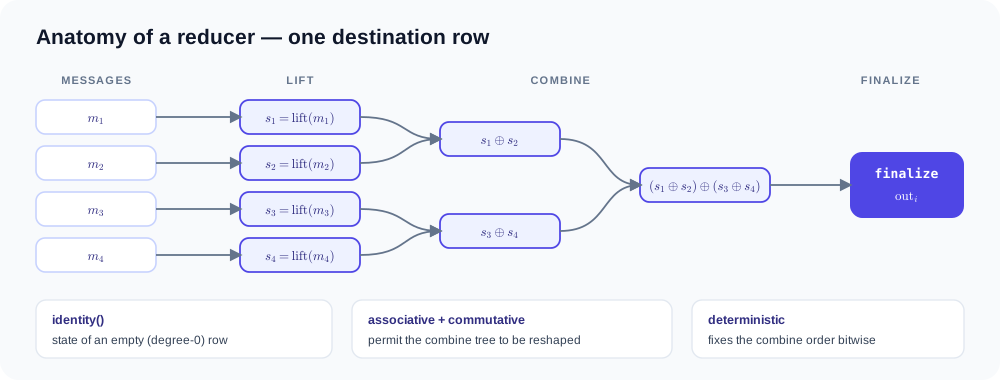
A reducer is executable algebra, not a name like "sum". It is the third
member of every MessagePassing program: the edge UDF produces messages, the
reducer defines how they combine into one value per destination node. The four
methods below are captured as first-class gf.reducer IR and fused with the
relation traversal before provider lowering — which is why the compiler can
generate the VJP of a hand-written reduction.
For one destination node i with incoming edge messages m_e, the semantics
are a fold:
The same fold as an ordinary Python loop — where each method runs:
for i in range(num_dst):                 # per destination node
    state = identity()                   # before its edges
    for e in edges_into(i):
        m = edge(src, dst, edge)         # the edge() UDF produces the message
        state = combine(state, lift(m))
    out[i] = finalize(state)             # after its edges
This shows the logical order, a left fold. A declared associative/commutative algebra frees the compiler to combine in any order or as a balanced tree.
Usage patterns
Every supported way to drive a reducer, each with a runnable example:
tg.sum(identity=…). The additive monoid, lowered to a direct segment
sum; gcn.py.
tg.mean(). The neighbor mean as built-in tuple state
(sum, count); inline below.
tg.prod(). The product monoid, promoted to a zero-safe product IR;
inline below.
tg.online_softmax(). Flash attention as a monoid over tuple state
(m, l, a), called as self.reducer(score, value);
tile_pruned_attention.py.
Tile pruning. block_prune_threshold lets the dense CUDA path skip
sub-threshold score tiles (a semantic approximation, off by default);
tile_pruned_attention.py.
Tuple state for a mean, written by hand. The algebra behind the
tg.mean() built-in spelled out as a custom reducer;
custom_reducer.py.
One-pass moments. Variance via (count, sum, sum_of_squares), proven
componentwise additive with a generated VJP;
inline below.
Product monoid, written by hand. The algebra behind the tg.prod()
built-in spelled out for gate reliability;
inline below.
Hand-written online softmax. The built-in algebra spelled out as a user reducer, taking the same lowering family; inline below.
Multi-message reducer calls. self.reducer(score, value) stages a
two-field binding instead of a value;
full_attention.py.
torch.nn-produced messages with tg.sum(). The message is a fused,
trainable edge MLP; edge_nn_message_passing.py.
torch.nn-produced scores with tg.online_softmax(). GAT-style
attention where the edge score is a small network; compiles to a
row-centric fused kernel (forward and backward);
gat_edge_attention.py.
Reducer inspection. reducer.mlir(...) returns the captured
gf.reducer op as text; custom_reducer.py.
The four region methods
| Method | Role | Default |
|---|---|---|
identity(self) |
state of an empty (degree-0) row | required |
lift(self, *messages) |
map one edge's message(s) to state | single message passthrough, or tuple |
combine(self, left, right) |
merge two states | required |
finalize(self, state) |
map the row's state to the node result | identity |
State may be a scalar or a tuple. A neighbor mean lifts values into
(value, count), combines the two components by addition, and finalizes by
dividing the sum by the count. See the runnable
custom reducer example.
Class attributes and __init__
| Attribute | Meaning | Effect on compilation |
|---|---|---|
name |
IR symbol name ("custom" default) |
part of the cache/specialization key |
associative |
grouping does not change the algebraic result | required True for native parallel lowering; never proven from Python source — the declaration is the contract |
commutative |
swapping operands does not change the algebraic result | allows the combine tree to reorder operands |
deterministic |
instance flag, __init__(*, deterministic=False) |
True picks a fixed-order sequential reduction (bitwise-stable); False allows a balanced tree |
These flags are trusted, not inferred: if associative = True is declared for
an algebra that is not associative, the generated parallel code is wrong and
that is a user error.
Calling a reducer inside edge
An ordinary single-message edge() returns src.value directly; the class
attribute already declares the reducer. In particular, built-in tg.sum()
expects a Tensor directly, not self.reducer(...). The following is the
explicit binding form for a custom reducer; the multi-input online-softmax
interface uses a similar form. It packages inputs for the declared reducer,
returning a staged binding, not performing aggregation inside one edge:
- At least one message is required (
TypeErrorotherwise). - Multiple messages are packaged as inputs;
liftthen constructs internal state. A message tuple is not itself the reducer state:return self.reducer(score, payload). - The staged item is what lets the compiler fuse lift into the edge region and keep combine/finalize in the reduction.
Built-in reducers, op by op
tg.sum(identity=0)
The additive monoid — every method is the trivial one:
The result is the sum of incoming messages, lowered directly to a segment sum.
identity changes the value a degree-0 row produces.
tg.mean()
The neighbor mean as built-in tuple state (s, n):
The result is the mean of incoming messages. The algebra is proven
componentwise additive, so the native path lowers it to two segment sums plus
a final divide, with a generated VJP. A degree-0 row finalizes 0/0 and
produces NaN — if isolated nodes should yield zeros, use tg.sum() and
divide by a clamped degree.
tg.prod()
The multiplicative monoid:
The result is the product of incoming messages, e.g. gate reliability: the
probability that every gate into i stays open. The compiler promotes it to
a zero-safe product IR with a generated VJP; a degree-0 row yields the
identity 1.
tg.online_softmax()
A softmax-weighted mean streamed over tuple state (m, l, a) — running
maximum, normalizer, weighted sum:
Here m = max(m1, m2) rescales both partial states into a common range
before merging; the result is a softmax-weighted mean of the values. Rescaling lives
inside combine, so partial states merge in any order and no score matrix is
ever materialized — this is flash attention's online softmax, written as a
monoid. It is called in edge as self.reducer(score, value). The score may
itself be a tg.nn.trace'd network (GAT-style learned attention): on CUDA
that compiles to a row-centric fused kernel with a fused backward — see the
GAT example.
accumulation_dtype— dtype of the streaming state.block_prune_thresholdin(0, 1]— a semantic approximation policy, not a schedule hint: a dense streaming implementation may skip a whole score tile when its maximum softmax weight falls below this ratio of the running block maximum.None(default) keeps exact online softmax. Currently only honored on the generated-CUDA DenseGraph path.
Why no max / min / median built-in? Max has a simple algebra, but
the native differentiable vocabulary has no maximum op with a subgradient
VJP yet. tg.online_softmax() computes a smooth weighted mean, not an exact
max, and cannot silently replace it. Median and quantiles are
different in kind: they are not associative monoids — no fixed-size state
combine(s, s') can accumulate a median — so they are fundamentally outside
one-pass reducer semantics and need a two-pass algorithm or a sketch
(t-digest, moments).
Neural networks in the message or the score
A tg.nn.trace'd torch.nn module fuses into the reduction at two points —
both compile to single fused CUDA kernels in which per-edge activations never
leave the tile, and both are trainable end to end (fields, positions and all
module weights receive generated gradients):
The nn produces the message, combined by tg.sum() — compiled to an
edge-centric tile kernel
(example):
The nn produces the score, combined by tg.online_softmax() — GAT-style
learned attention, compiled to a row-centric online-softmax tile kernel with
a fused backward
(example):
The score chain must produce one scalar per edge (out_features=1), and the
softmax value must be a field gather. An nn inside a custom reducer
matches no fusion form and falls back to the exact eager oracle — correct,
not fast. The op whitelist, LayerNorm support and launch-geometry knobs live
in the message passing guide.
Inventing a reducer
Three algebras that actually run on the native path — each one is recognized by the compiler as a proven form, so the forward kernel and its VJP are both generated. Built-ins are conveniences, not privileged compiler paths.
Neighbor variance in one pass
One traversal accumulates (count, sum, sum_of_squares) for feature
normalization layers that need neighborhood statistics. Finalization computes:
class Variance(tg.Reducer):
    associative = True
    commutative = True

    def identity(self):
        return 0.0, 0.0, 0.0                 # (count, sum, sum of squares)

    def lift(self, value):
        return 1.0, value, value * value

    def combine(self, left, right):
        return (left[0] + right[0],
                left[1] + right[1],
                left[2] + right[2])

    def finalize(self, state):
        mean = state[1] / state[0]
        return state[2] / state[0] - mean * mean


class NeighborVariance(tg.MessagePassing):
    reducer = Variance()

    def edge(self, src, dst, edge):
        return self.reducer(src.x)


out = NeighborVariance()(graph=graph, src={"x": x}, dst={})  # (N,)
Structurally proven componentwise additive. Note that finalize also
runs on identity() for degree-0 rows — here an isolated node divides
0/0, so pick an identity/finalize pair with empty rows in mind.
Product of edge gates
Reliability-style aggregation multiplies incoming edge probabilities: the probability
that every gate into i stays open. This is exactly the algebra the
tg.prod() built-in ships — spelled out here to show the mechanics:
class Product(tg.Reducer):
    associative = True
    commutative = True

    def identity(self):
        return 1.0

    def combine(self, left, right):
        return left * right


class GateReliability(tg.MessagePassing):
    reducer = Product()

    def edge(self, src, dst, edge):
        return self.reducer(edge.open_probability)
lift and finalize inherit the base-class defaults (passthrough). The
compiler proves the product monoid from the expression tree — identity
1, passthrough lift, mul combine — and promotes it to a zero-safe product
IR with a generated VJP.
Online softmax, written by hand
tg.online_softmax() is not magic — the same algebra as a user reducer is
structurally proven stable-weighted and takes the same lowering family:
class Softmax(tg.Reducer):
    associative = True
    commutative = True

    def identity(self):
        return float("-inf"), 0.0, 0.0       # (max, denominator, numerator)

    def lift(self, score, value):
        return score, 1.0, value

    def combine(self, left, right):
        m = left[0].maximum(right[0])
        l = left[1] * (left[0] - m).exp() + right[1] * (right[0] - m).exp()
        a = left[2] * (left[0] - m).exp() + right[2] * (right[0] - m).exp()
        return m, l, a

    def finalize(self, state):
        return state[2] / state[1]
The captured scalar vocabulary is arithmetic, .exp() and .maximum() over
tuple state. Algebras matching no proven form still run — as a general
explicit reduction tree (arithmetic and exp), correctness-only, never a
performance claim.
How the compiler picks a lowering
On the native path, reducers are matched by structure, in this order:
tg.sum()→ direct segment sum; an nn-subgraph message lowers further to the fused edge-centric tile kernel (and its symbolic-VJP backward);tg.mean()→ proven componentwise-additive tuple state: two segment sums plus a final divide, with a generated VJP;tg.prod()→ proven product monoid, promoted to a zero-safe product IR with a generated VJP;tg.online_softmax()→ tiled stable streaming path; an nn-subgraph score lowers further to the row-centric fused attention kernel (and its fused backward);- user reducers proven stable-weighted, product monoid (promoted to zero-safe product IR), or componentwise additive (tuple state) → generated reduction with generated VJP;
- anything else → a general explicit reduction tree: sequential when
deterministic=True, balanced otherwise; scalar result.
Shapes that match no proven form remain correctness-only claims, never performance claims.
Inspecting a reducer
reducer.mlir(message_dtypes=(tg.float32,), symbol="user_mean") captures the
four regions as a verified gf.reducer op and returns its text — the same
artifact the custom reducer example points at. A reducer's flags and
constructor configuration form its specialization key, so two reducers with
different algebra never share a compiled cache entry.
See the API reference for the flat listing.