Dynamic graph acceleration
A dynamic graph is not one storage format. It is a logical relation whose
neighbor set depends on changing data. Tiga keeps that relation semantic
in IR long enough to choose whether edges should be generated, cached,
incrementally repaired, partitioned, or paged. Materializing CSR is one legal
realization, not the default meaning of Graph.radius or Graph.knn.
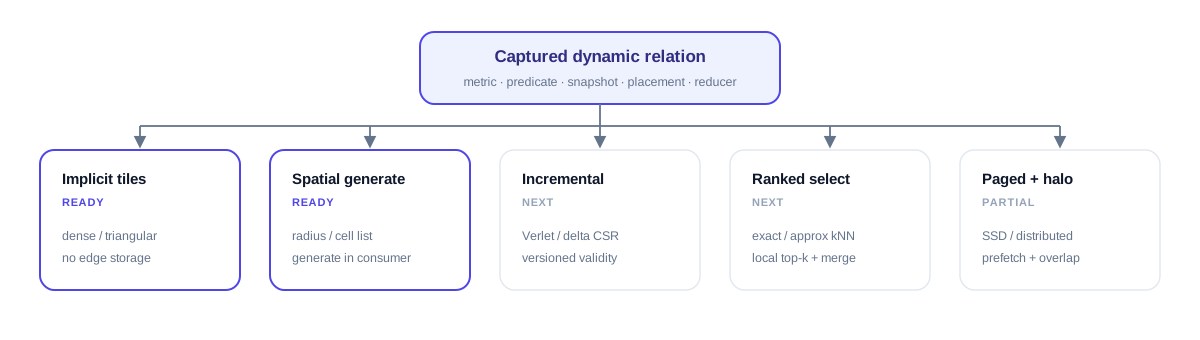
Open the full-size SVG. The realization is a compiler choice; it is not a different user Graph type.
The realization matrix
This matrix combines native and Torch-adapter implementations with explicitly marked plans. Generated CUDA traversal is not the native MessagePassing default: native radius currently consumes materialized CSR, and native kNN/dense MessagePassing is not supported. See coverage.
| Relation and lifecycle | Physical structure | Compiler opportunity | Best regime | Current status |
|---|---|---|---|---|
| Fixed grid stencil | CSR generated from grid dimensions and offsets | reuse topology across field updates; an offset-only traversal is a separate optimization | regular-grid filtering and local updates | CPU/CUDA constructor and Torch execution available; currently materializes CSR |
| Dense Cartesian or triangular | no edge array; query/source tiles | fuse message, online reducer and value contraction; keep state in registers/shared memory | attention, all-pairs kernels whose output is much smaller than the relation | executable and benchmarked |
| Euclidean radius, rebuilt | sorted cell directory plus occupied-cell ranges | generate candidates inside the consumer, reject by distance, and avoid CSR/distance/message tensors | low-dimensional particles with bounded cell occupancy | executable for 2D/3D default metric, including periodic box/skew cases |
| Radius with bounded motion | cell directory or neighbor list plus a skin | reuse while the displacement certificate holds; rebuild only on invalidation | molecular dynamics and time stepping with coherent motion | snapshot/version reuse exists; a full Verlet invalidation policy is next work |
| Exact kNN | candidate tiles plus hierarchical local top-k and merge | fuse distance, selection and consume; keep M0 selection state register-local | exact low/moderate-dimensional search | executable FP32 squared-Euclidean M0; three strict gates pass; large-k/metric/spill remains partial |
| Approximate kNN | IVF/HNSW/tree directory plus refinement relation | compile probe/refine as nested generated relations and expose recall as part of the contract | high-dimensional search where exact all-pairs is unnecessary | planned; no performance claim |
| Mutable edge stream | immutable CSR base plus sorted delta segments/tombstones | fuse base and delta traversal, compact asynchronously, version snapshots | temporal/social graphs with small batches of edge updates | planned |
| Skewed materialized graph | degree CDF worklists and chunked high-degree tails | different schedules for short rows and split rows; disjoint output ownership avoids atomics | power-law social graphs | executable and benchmarked |
| SSD/distributed graph | paged CSR for offload; destination shards and a halo plan for distributed execution | page through topology, or exchange the halo before computing owned rows | large stored graphs and spatial partitions | single-device paging and two-host NCCL measured separately; see experiments |
“Dynamic” therefore has at least three independent axes:
- topology change: none, bounded motion, batched deltas, or full rebuild;
- relation density: sparse materialized, sparse generated, or implicit dense;
- residency: one device, host-backed, SSD-paged, or distributed shards.
Those facts belong in the captured relation and its snapshot token. They should
not be handwritten cache(..., space="shared") hints in every user kernel.
Fixed rules are generated, not necessarily dynamic
Graph.stencil(dims, offsets=None, periodic=False) defines source coordinates as
the destination coordinate plus each offset. No positions or distance search
are required. Changing node values does not change this topology. The current
constructor materializes CSR; it does not promise an implicit, edge-free kernel.
See the five-point grid example
for indexing, periodic boundaries and Torch gradients.
Omitting offsets uses tg.stencil.von_neumann(); tg.stencil.moore() and
explicit tuples are also supported. See neighborhood macros
and radius/kNN distance metrics.
Generated radius traversal
For a default Euclidean radius graph, the compiler may lower
%%{init: {'theme':'base', 'themeVariables': {'primaryColor':'#eef2ff','primaryBorderColor':'#4f46e5','primaryTextColor':'#312e81','lineColor':'#64748b','fontFamily':'Arial'}}}%%
flowchart LR
    A[destination particle] --> B[cell coordinate] --> C[adjacent occupied cells]
    C --> D[candidate source particles] --> E[exact metric / select predicate]
    E --> F[message + reducer]
On the generated CUDA path, the directory is O(N + cells) and edges need
not exist as an array in global memory. Build/consume fusion removes four otherwise materialized arrays: row
pointers, column indices, edge distances and messages. The archived dynamic
benchmark compares the resulting build-and-consume
path with explicit construction and aggregation.
Custom metrics need a proven broad-phase bound before they may use this path.
Without one, Tiga retains exact semantics and selects a general fallback.
A select UDF may remove candidates but cannot bypass the radius predicate.
CUDA hash-directory implementation and matched Warp comparison
Contiguous FP32 2D/3D non-periodic Euclidean inputs use a fixed-size modular
hash grid. Torch-compiled
preprocessing computes bucket keys; vendor sort/search primitives build their
ranges. Tiga emits the neighbor traversal, exact distance predicate and scalar
distance-weighted sum through Domain/Iter/Kernel IR. Bucket wrapping is hashing,
not periodic geometry: collisions add candidates, never accepted edges. Periodic
geometry retains the separate dense directory. Custom metrics keep their exact
fallback. This path does not cover general EdgeNN fusion; backward may still materialize CSR.
Index snapshots and ordinary outputs own independent storage, even through
detach() aliases. Only private index scratch is explicitly reused. Inference
tensors have no version counter, so data-dependent caches conservatively rebuild.
September 20, 2026 validation on RTX 5070 Ti, Torch 2.11.0+cu128, Triton 3.6.0,
Warp 1.9.1: 131,072 uniform 3D points, approximately 4.02M directed edges,
one FP32 feature, sum(distance * x), no self edges or neighbor truncation.
All rows in both coordinate snapshots match an independent materialized reference
(maximum absolute error below 5e-7).
| Implementation | Index build (ms) | Fixed-index compute (ms) | Rebuild + compute (ms) | Peak allocated buffers (MiB) |
|---|---|---|---|---|
| Tiga dense-directory baseline | 0.4030 | 1.2374 | 1.6968 | 21.68 |
| Tiga hash-directory | 0.1808 | 0.3218 | 0.5626 | 16.00 |
| Warp hash grid | 0.0620 | 0.2469 | 0.2905 | 8.78 |
The new Tiga path is about 3.02× faster than the dense baseline for rebuild plus compute on this case. Warp remains faster and uses less allocated memory. These numbers do not establish a general radius-search advantage over Warp. Earlier EdgeNN charts use different computations and timing boundaries.
Each provider runs in a fresh process with five warmups and 30 samples per phase. Times are synchronized wall-clock medians; changing coordinates is outside the timer for both providers. Fixed-index execution disables Tiga's adaptive CSR cache, so both methods query their spatial index. Allocation peaks include inputs and provider scratch, not driver/modules or reserved free blocks; Warp's reported upper bound combines its pool high-water counter with constant Torch inputs. CUDA-event samples, both snapshot hashes and source hashes are in the raw records: Tiga, dense baseline, Warp.
Run the matched benchmark source
after installing optional benchmark-only warp-lang==1.9.1:
for provider in tiga tiga-dense warp; do
  python benchmarks/graph_operations/warp_radius.py --provider "$provider" \
    --nodes 131072 --repeats 30 --output "output/radius-$provider.json"
done
The benchmark is separate from ordinary installation; Tiga does not depend on Warp.
Exact kNN needs hierarchical selection
Exact kNN is an executable ranked-relation lowering rather than a library dispatch; the measured gates are reported in benchmark results. The compiler path is:
%%{init: {'theme':'base', 'themeVariables': {'primaryColor':'#eef2ff','primaryBorderColor':'#4f46e5','primaryTextColor':'#312e81','lineColor':'#64748b','fontFamily':'Arial'}}}%%
flowchart LR
    A[query tile × candidate tile] --> B[metric UDF] --> C[local k selections]
    C --> D[hierarchical merge] --> E[selected-edge message / reducer]
These steps are represented by provider-neutral Domain/Iter/Kernel IR and the
core emits TTIR—there is no workload-named Python/Triton kernel. M0 keeps the
physical key state at next_pow2(k), masks lanes beyond the exact semantic k
and therefore supports every k≤64 without global scratch. Larger k still needs
a memory-budgeted multi-task spill plan; a spatial directory may be chosen
only when exactness can be certified. Approximate search is a different public
contract and must report recall as well as speed.
Load balance for power-law graphs
One thread block per row wastes most lanes on short rows and stalls on hubs. Tiga records the degree distribution and selects a mixed schedule:
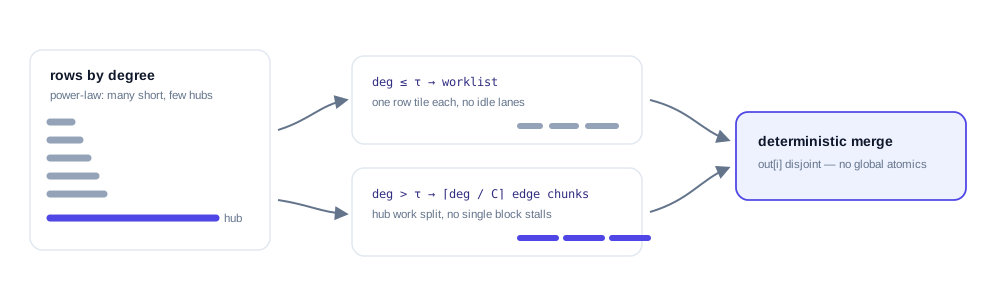
For a row i of degree d_i with chunk size C and degree threshold
tau, the schedule and the merge it preserves are:
- short and medium rows enter degree-CDF worklists with row-specific tiles;
- high-degree rows split into fixed-size edge chunks;
- chunk partials are finalized through a deterministic task dependency;
- destination ownership remains disjoint, avoiding global output atomics;
- the planner may reorder physical rows while preserving logical IDs.
This mechanism is useful for PageRank, aggregation and many NetworkX-style algorithms that are expressible as frontier/relation/reducer programs. Frontier compaction and sorted-intersection are still required for efficient BFS and triangle counting; they are compiler diagnostics on the roadmap, not completed claims.
Incremental, paged and distributed execution
A snapshot token connects positions or edge deltas to the selected realization. Reuse is legal only while its certificate remains valid. For bounded particle motion, a future Verlet plan will track maximum displacement and rebuild when the skin is exhausted. For temporal graphs, a base CSR plus delta segments can serve the same role, with compaction scheduled outside the critical path.
The two reuse contracts, written out — the Verlet certificate on the left
(each particle moves less than half the extra neighbor-list radius), the temporal base-plus-delta form
on the right (base CSR B, edge insertions Δ⁺, tombstones
Δ⁻):
%%{init: {'theme':'base', 'themeVariables': {'primaryColor':'#eef2ff','primaryBorderColor':'#4f46e5','primaryTextColor':'#312e81','lineColor':'#64748b','fontFamily':'Arial'}}}%%
flowchart LR
    S[snapshot + certificate] -->|certificate holds| U[reuse, no rebuild]
    U -->|certificate violated| R[rebuild relation]
    R --> S
For large stored graphs, Graph.open(...) exposes paged topology through the
MessagePassing interface. Distributed execution is a separate placement path:
the runtime packs, exchanges and unpacks the halo, then computes all owned rows.
The public policy is communication then compute, not split interior/boundary
overlap. Placement and halo depth are graph properties; communication is managed
by the runtime. Single-device paging and two-host NCCL results are reported
separately in experiments; these do not establish a combined
distributed-offload capacity guarantee.
Performance boundaries
Every dynamic benchmark states which boundary it measures; benchmark results defines the build-only, consume-only, build + consume and certified-reuse boundaries and reports the measured cases, and the performance methodology defines the acceptance rules.